
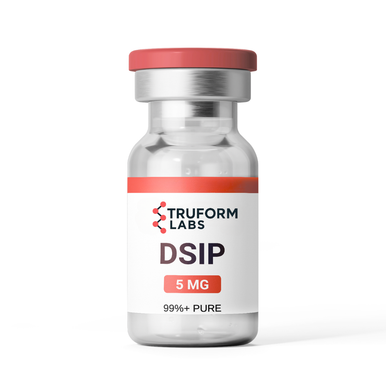
DSIP (Delta Sleep Inducing Peptide) 5MG
Log in to view pricing
Apply for provider account
49 in stock
DSIP (Delta Sleep-Inducing Peptide)
DSIP is a synthetic nonapeptide (Trp–Ala–Gly–Gly–Asp–Ala–Ser–Gly–Glu) originally isolated from rabbit cerebral venous blood and characterized for its ability to induce slow-wave (delta) sleep when administered centrally in animal models.[1][2] DSIP and its analogs enhance delta and spindle EEG activity, supporting a sleep-promoting role.[1][2] However, the precise physiological function and endogenous regulation of DSIP in humans remain incompletely understood, and a specific DSIP receptor has not been confirmed.[3]
Preclinical studies show DSIP and fusion peptides can cross the blood–brain barrier and modulate serotonin, dopamine, glutamate, and melatonin systems implicated in sleep and circadian regulation.[4][5] In animal models, DSIP increases non-REM and REM sleep, reduces sleep latency, and improves sleep architecture—particularly under stress or hypoxic conditions.[6][5][1][2] DSIP also exhibits stress-protective and antioxidant effects, enhancing mitochondrial oxidative phosphorylation/ATP production in rat brain mitochondria and mitigating hypoxia-induced dysfunction.[7] It modulates neuroendocrine stress responses (substance P, β-endorphin, corticosterone), potentially enhancing resilience to stressors.[8]
Clinical data are limited. In a double-blind, placebo-controlled trial in chronic insomniacs, IV DSIP (25 nmol/kg) modestly improved objective sleep efficiency and reduced sleep latency, though subjective sleep quality and tiredness were unchanged.[9] CSF DSIP-like immunoreactivity has correlated with delta sleep in humans, but clinical significance is unclear.[10] Overall, DSIP’s role in human sleep regulation is less established than other neuropeptides such as GHRH and CRH.[11][12]
DSIP has also been investigated for restoring cognitive function and memory in models of sleep deprivation and hypoxia, with phosphorylated DSIP analogs improving spatial memory and hippocampal CREB phosphorylation.[6] Its stress-protective, antioxidant, and neuroendocrine-modulating actions may underlie broader therapeutic potential.
Typical research doses in animals range from microgram to milligram quantities, with 10 mg referenced in experimental protocols; optimal human dosing and long-term safety have not been established.[9][5][7]
In summary, DSIP is a neuropeptide with demonstrated sleep-promoting, stress-protective, and neuromodulatory effects in preclinical models, and limited evidence for sleep improvement in humans. Its precise physiological role, clinical efficacy, and safety profile require further investigation.[3][9][6][11][5][10][7][8][1][2][12]
References
- Schoenenberger GA, Monnier M. Proc Natl Acad Sci USA. 1977;74(3):1282-6. doi:10.1073/pnas.74.3.1282.
- Schoenenberger GA, Maier PF, Tobler HJ, Wilson K, Monnier M. Pflügers Arch. 1978;376(2):119-29. doi:10.1007/BF00581575.
- Kovalzon VM, Strekalova TV. J Neurochem. 2006;97(2):303-9. doi:10.1111/j.1471-4159.2006.03693.x.
- Mu X, Qu L, Yin L, et al. Front Pharmacol. 2024;15:1439536. doi:10.3389/fphar.2024.1439536.
- Zhang XG, Wang WN, Zhang CS, et al. Protein Pept Lett. 2017;24(7):668-675. doi:10.2174/0929866524666170426113022.
- Roy K, Chauhan G, Kumari P, et al. Life Sci. 2018;209:282-290. doi:10.1016/j.lfs.2018.08.026.
- Khvatova EM, Samartzev VN, Zagoskin PP, et al. Peptides. 2003;24(2):307-11. doi:10.1016/S0196-9781(03)00040-8.
- Sudakov KV, Coghlan JP, Kotov AV, et al. Ann N Y Acad Sci. 1995;771:240-51. doi:10.1111/j.1749-6632.1995.tb44685.x.
- Bes F, Hofman W, Schuur J, Van Boxtel C. Neuropsychobiology. 1992;26(4):193-7. doi:10.1159/000118919.
- van Kammen DP, Widerlöv E, Neylan TC, et al. Sleep. 1992;15(6):519-25. doi:10.1093/sleep/15.6.519.
- Steiger A, Holsboer F. Sleep. 1997;20(11):1038-52.
- Obal F, Krueger JM. Front Biosci. 2003;8:d520-50. doi:10.2741/1033.
All COA’s avail upon request by email info@truformlabs.com.
Storage & Handling (Research Use)
- Lyophilized (dry) peptide: Store sealed at −20 °C (long-term). Short-term storage up to 2–3 weeks at 2–8 °C is acceptable.
- After reconstitution: Store at 2–8 °C and use within 7 days, or aliquot into sterile vials and freeze at −20 °C for up to 3 months.
- Light & moisture: Protect from light; keep container tightly closed to avoid moisture uptake.
- Freeze–thaw: Avoid repeated freeze–thaw cycles (use aliquots).
- Solvent compatibility: Choose sterile solvent compatible with your protocol; filter-sterilize if required by your procedures.
- Labeling: Clearly label aliquots with concentration, solvent, and date of preparation.
Storage guidance is general for research peptides and may be adjusted per your lab SOP.