
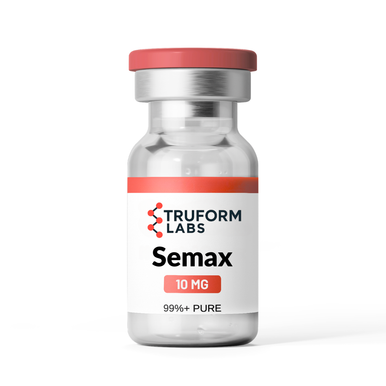
N-Acetyl Semax – 10MG
Log in to view pricing
Apply for provider account
Semax: Neuroprotective Peptide Profile
N-Acetyl Semax is a heptapeptide analog of ACTH(4-10) with N-terminal acetylation, characterized by neuroprotective, neurotrophic, and anti-inflammatory actions across ischemic stroke, spinal cord injury (SCI), cognition, and stress-related models.
Neuroprotection & Functional Recovery
- In cerebral ischemia/reperfusion, Semax upregulates active CREB and suppresses MMP-9, c-Fos, and JNK—counteracting ischemia-driven transcriptomic disruption and supporting neuronal survival.[1,2]
- In SCI, Semax targets Oprm1 (μ-opioid receptor), modulates USP18-mediated deubiquitination, and reduces lysosomal membrane permeabilization and pyroptosis, improving recovery and oxidative stress indices.[3]
Immune/Vascular Gene Programs & Neurotrophins
- Enhances expression of immune/vascular genes (immunoglobulins, chemokines, endothelial migration/vasculogenesis) after focal ischemia.[4]
- Rapid, region-specific induction of neurotrophins (NGF, BDNF) and increases in BDNF protein and TrkB phosphorylation—linked to learning, memory, and synaptic plasticity.[5–9]
N-Acetylation & Metal-Ion Interactions
- N-acetylation (Ac-Semax) shifts Cu(II) coordination to a [CuLH] species with a distorted CuNO chromophore and more positive redox potential; unlike non-acetylated Semax, Ac-Semax does not protect against Cu(II)-induced toxicity in neuroblastoma cells, underscoring the role of a free N-terminus.[10,11]
- Both Semax and Ac-Semax form Zn(II) complexes of comparable strength; acetylation does not affect Zn(II) influx or localization.[10]
Stress, Mood & Monoaminergic Systems
- Antidepressant-like and antistress effects in chronic unpredictable stress, reversing anhedonia, adrenal hypertrophy, and hippocampal BDNF depletion.[12]
- Activates dopaminergic and serotonergic systems; augments psychostimulant-evoked dopamine release; proposed utility in ADHD and Rett syndrome.[14,15]
Angiogenesis & Cellular Repair
- Promotes proliferation of neuroglia, endothelial cells, and SVZ progenitors; activates capillary networks in normal and ischemic brain, improving perfusion and limiting damage.[13]
Key Takeaways
- Multi-modal neuroprotection: anti-inflammatory, anti-apoptotic/anti-pyroptotic, pro-plasticity.
- Gene-level reprogramming: boosts immune/vascular pathways and neurotrophin signaling.
- Chemistry matters: N-terminal acetylation modulates Cu/Zn binding and may tune bioactivity in metal-dyshomeostasis states.
References
- Sudarkina OY, et al. Int J Mol Sci. 2021;22(12):6179.[1]
- Filippenkov IB, et al. Genes. 2020;11(6):E681.[2]
- Liu R, et al. Br J Pharmacol. 2025.[3]
- Medvedeva EV, et al. BMC Genomics. 2014;15:228.[4]
- Agapova TY, et al. Neurosci Lett. 2007;417(2):201–205.[5]
- Shadrina M, et al. J Mol Neurosci. 2010;41(1):30–35.[6]
- Dolotov OV, et al. Brain Res. 2006;1117(1):54–60.[7]
- Dmitrieva VG, et al. Cell Mol Neurobiol. 2010;30(1):71–79.[8]
- Dolotov OV, et al. J Neurochem. 2006;97(S1):82–86.[9]
- Magrì A, et al. J Inorg Biochem. 2016;164:59–69.[10]
- Tabbì G, et al. J Inorg Biochem. 2015;142:39–46.[11]
- Inozemtseva LS, et al. Eur J Pharmacol. 2024;984:177068.[12]
- Stavchansky VV, et al. J Mol Neurosci. 2011;45(2):177–185.[13]
- Tsai SJ. Med Hypotheses. 2007;68(5):1144–1146.[14]
- Eremin KO, et al. Neurochem Res. 2005;30(12):1493–1500.[15]
All information provided is for research purposes only.
All COA’s available upon request: info@truformlabs.com
All information provided is for research purposes only.
Storage & Handling (Research Use)
- Lyophilized powder: Store sealed at −20 °C to −80 °C (desiccated, light-protected). Short-term (≤2–3 weeks) at 2–8 °C is acceptable.
- After reconstitution: Store at 2–8 °C and use within 7 days, or aliquot and freeze at −20 °C to −80 °C for ≤3 months.
- Handling: Prepare small aliquots to avoid freeze–thaw; keep on ice during prep; minimize air/light exposure.
- Vehicle & pH: Reconstitute per lot guidance (e.g., sterile saline/BWFI) near pH 7.0–7.4; avoid reactive metals/oxidants.
- Labeling: Record concentration, solvent, and prep date; follow lab SOPs and lot-specific stability notes.
All information provided is for research purposes only.