
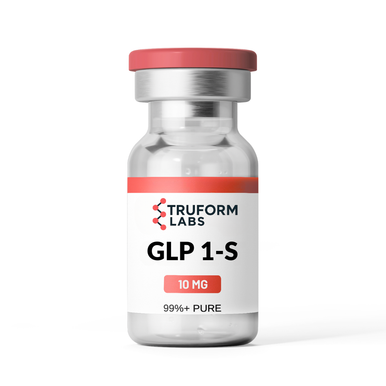
GLP 1-S – 10 MG
Log in to view pricing
Apply for provider account
5142 in stock
GLP-1 S
GLP-1 S is a long-acting glucagon-like peptide-1 (GLP-1) receptor agonist approved for chronic weight management and glycemic control in adults with obesity or type 2 diabetes. It mimics endogenous GLP-1, acting on central and peripheral pathways to suppress appetite, delay gastric emptying, increase glucose-dependent insulin secretion, decrease glucagon release, and promote pancreatic β-cell growth.[1][2]
Efficacy for Weight Loss & Obesity Management
Indicated for adults with BMI ≥30 kg/m² or ≥25 kg/m² with a weight-related comorbidity.[3][2][4] In STEP 1 and STEP 3, mean weight loss at 68 weeks was 14.9% and 16.0%, respectively, vs 2.4% and 5.7% with placebo. Most participants achieved ≥10% loss, and over half achieved ≥15% loss.[1][5–7] Benefits are maintained with continued therapy; discontinuation often leads to weight regain, underscoring the need for long-term treatment.[1][5][7]
Glycemic Control & Cardiometabolic Benefits
- Significant reductions in HbA1c and fasting glucose in type 2 diabetes.[8–11][2][5]
- Lowers blood pressure, improves lipid profiles, and reduces inflammatory markers (e.g., CRP).[4][6]
- Recommended by ADA and AGA as a first-line pharmacologic option for weight management in adults with obesity and/or type 2 diabetes.[11][2]
Cardiovascular & Renal Outcomes
- Reduces MACE, cardiovascular mortality, and all-cause mortality in high-risk populations per large trials/meta-analyses.[12–15][4]
- Kidney-protective effects; recommended for CKD with type 2 diabetes.[12][15][2]
Safety & Tolerability
- Most common AEs are GI (nausea, vomiting, diarrhea); discontinuation rates similar to placebo in trials.[5–7]
- Rapid weight loss may increase risk of gallstones/hepatobiliary disorders.[6]
- No consistent link with increased cancer or psychiatric AEs confirmed.[7]
- Low hypoglycemia risk as monotherapy.[8–10][2]
Clinical Considerations
- Use alongside nutrition and physical-activity interventions.[1][2][6]
- Plan for long-term therapy; counsel on potential weight regain after stopping.[1][5][7]
- Individualize therapy based on comorbidities, preferences, and access.[2][7]
References
- Elmaleh-Sachs A, Schwartz JL, Bramante CT, et al. JAMA. 2023;330(20):2000-2015.
- Grunvald E, Shah R, Hernaez R, et al. AGA Guideline. Gastroenterology. 2022;163(5):1198-1225.
- FDA Orange Book.
- Joseph JJ, Deedwania P, Acharya T, et al. AHA Statement. Circulation. 2022;145(9):e722-e759.
- Bergmann NC, Davies MJ, Lingvay I, Knop FK. Diabetes Obes Metab. 2023;25(1):18-35.
- Wadden TA, Bailey TS, Billings LK, et al. STEP 3. JAMA. 2021;325(14):1403-1413.
- Ferrara F, Bazzani D, Crivelli B, et al. Naunyn-Schmiedeberg’s Arch Pharmacol. 2025.
- Blonde L, Fonseca V. Endocr Pract. 2018.
- Sheahan KH, Wahlberg EA, Gilbert MP. Postgrad Med J. 2020;96:156-161.
- Sharma D, Verma S, Vaidya S, et al. Biomed Pharmacother. 2018;108:952-962.
- ADA/EASD Consensus. Diabetes Care. 2022;45(11):2753-2786.
- Salama L, Sinn L. Am J Health-Syst Pharm. 2025.
- Sachinidis A, Nikolic D, Stoian AP, et al. Metabolism. 2020;111:154343.
- Drucker DJ. Diabetes. 2018;67(9):1710-1719.
- Galli M, Benenati S, Laudani C, et al. J Am Coll Cardiol. 2025.
- Knop FK, Aroda VR, do Vale RD, et al. OASIS-1. Lancet. 2023;402:705-719.
All COA’s avail upon request by email info@truformlabs.com.
Storage & Handling (Research Use)
- Lyophilized (dry) peptide: Store sealed at −20 °C (long-term). Short-term storage up to 2–3 weeks at 2–8 °C is acceptable.
- After reconstitution: Store at 2–8 °C and use within 7 days, or aliquot to sterile vials and freeze at −20 °C for up to 3 months.
- Light & moisture: Protect from light; keep container tightly closed to avoid moisture uptake.
- Freeze–thaw: Avoid repeated freeze–thaw cycles (prepare small aliquots).
- Solvent compatibility: Use a sterile, compatible solvent per your protocol; filter-sterilize if required.
- Labeling: Clearly label aliquots with concentration, solvent, and preparation date.