
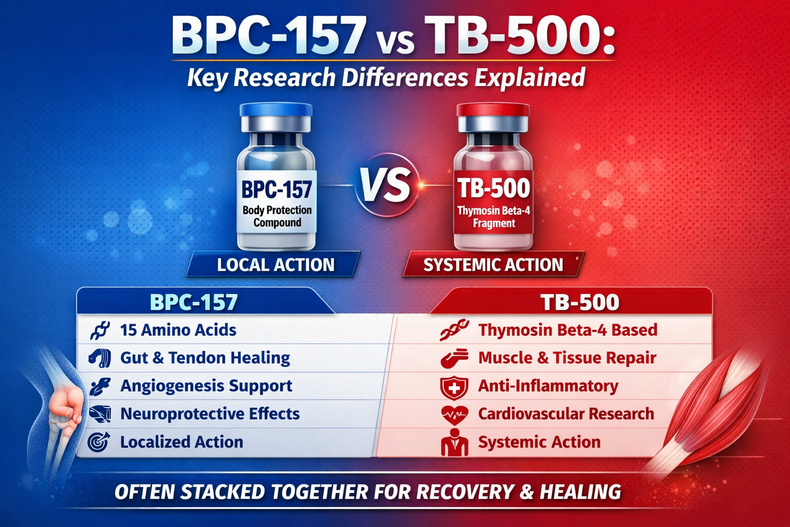
You've probably seen both of these peptides mentioned together. A lot.
And for good reason - BPC-157 and TB-500 are two of the most researched peptides in the recovery and regeneration space. They're often stacked together. But they're not the same thing.
Not even close.
Both are studied for their potential roles in recovery and tissue repair.
Both are widely discussed in research communities.
And both are often compared side by side.
This article breaks down exactly what makes each one unique, what the research says, and how they compare head-to-head.
What Is BPC-157?
BPC stands for Body Protection Compound.
It is a synthetic peptide derived from a naturally occurring protein found in gastric (stomach) juices.
It's a synthetic peptide made up of 15 amino acids. It was originally derived from a protein found in human gastric juice. Yes, stomach fluid. That's where it gets its remarkable gut-healing reputation.
BPC-157 has been studied extensively in animal models. Researchers have looked at how it affects wound healing, tendon repair, ligament recovery, gut inflammation, and even neurological function.
It's short. It's stable. And it seems to work through multiple pathways at once.
Researchers have studied BPC-157 for its potential role in:
-
Supporting tissue repair
-
Studying gut lining protection
-
Investigating tendon and ligament recovery
-
Exploring blood vessel formation (angiogenesis)
What Is TB-500?
TB-500 is a synthetic version of Thymosin Beta-4, a naturally occurring peptide found in almost every tissue in the human body.
Your body already makes Thymosin Beta-4. It plays a key role in how cells move, how blood vessels form, and how tissue repairs itself after injury.
TB-500 is a fragment of the full Thymosin Beta-4 molecule. Researchers identified the most active portion and isolated it. The result is a peptide that's highly bioavailable and travels easily through the body.
That systemic reach is one of its defining characteristics.
TB-500 is studied for its potential effects on:
-
Muscle tissue recovery
-
Cell movement (actin regulation)
-
Wound repair models
-
Inflammation-related research
The Core Difference: Local vs Systemic
This is the most important thing to understand.
BPC-157 tends to work locally. It concentrates its effects near the site of injury or administration. Think of it as targeted repair.
TB-500 works systemically. It circulates through the body and can act on tissue far from the injection site. Think of it as a body-wide recovery signal.
Both are powerful. But they operate differently.
What Does the Research Say About BPC-157?
Animal studies on BPC-157 are extensive. Here's what researchers have explored:
Tendon and ligament healing. Several studies in rats showed significantly faster tendon repair after BPC-157 administration. Researchers observed increased collagen production and improved tensile strength in damaged tendons.
Gut health and IBD. BPC-157 was originally studied for its protective effects on the gastrointestinal tract. Research suggests it may help with stomach ulcers, inflammatory bowel conditions, and intestinal damage from NSAIDs.
Bone healing. Some studies looked at fracture repair in animals. BPC-157 appeared to accelerate bone regeneration.
Neurological effects. More recent research has explored BPC-157's role in brain health. It may have neuroprotective properties and could support dopamine and serotonin system function.
Blood vessel formation. BPC-157 appears to promote angiogenesis — the growth of new blood vessels — which is essential for healing damaged tissue.
One of BPC-157's big advantages in research is its oral stability. Unlike many peptides, it may retain some activity when taken orally, making it interesting for gut-related applications.
What Does the Research Say About TB-500?
TB-500 research has focused heavily on systemic tissue repair and anti-inflammatory effects.
Muscle repair. Studies have looked at TB-500's ability to accelerate muscle recovery after injury. It promotes cell migration to injury sites and helps rebuild damaged muscle fibers.
Heart tissue. Some of the more compelling research involves cardiac muscle. Animal studies have explored whether TB-500 can help regenerate heart tissue after damage — a finding with significant implications.
Blood vessel growth. Like BPC-157, TB-500 promotes angiogenesis. It does this partly by upregulating actin — a structural protein critical to cell movement and tissue formation.
Reduced inflammation. TB-500 has demonstrated anti-inflammatory properties in multiple studies, which can support faster healing across various tissue types.
Flexibility in injured tissue. Research suggests TB-500 may help restore flexibility and reduce scar tissue formation — important for functional recovery, not just structural repair.
Its systemic action makes TB-500 particularly useful when the location of injury is diffuse or hard to pinpoint.
BPC-157 vs TB-500: Side-by-Side Comparison
| Feature | BPC-157 | TB-500 |
|---|---|---|
| Origin | Derived from gastric protein | Derived from Thymosin Beta-4 |
| Size | 15 amino acids | ~17 amino acids (fragment) |
| Action | Primarily local | Primarily systemic |
| Gut healing | Strong research support | Limited research here |
| Tendon/ligament | Extensively studied | Some evidence |
| Muscle repair | Some evidence | Strong research support |
| Cardiovascular | Limited | Notable animal research |
| Neurological | Growing evidence | Less studied |
| Oral activity | Potentially active orally | Typically injected |
| Natural in body | No | Yes (TB-4 is endogenous) |
Why Researchers Often Study Them Together
Because they complement each other.
BPC-157 targets the specific injury site with precision. TB-500 signals the whole body to enter a recovery state. Together, they cover both angles — local repair and systemic support.
In research models, combining the two has been explored for accelerating overall recovery timelines. They don't appear to compete with each other. They work on different pathways and different scales.
This is why the "BPC-157 + TB-500 stack" is one of the most commonly discussed combinations in peptide research literature.
Key Mechanisms: How Each One Works
BPC-157 works through:
- Stimulating growth hormone receptors
- Promoting nitric oxide production
- Upregulating growth factors like VEGF and EGF
- Direct cytoprotective effects on cells
TB-500 works through:
- Binding to actin to promote cell migration
- Upregulating cell surface receptors for growth factors
- Reducing inflammatory cytokines
- Stimulating new blood vessel formation at a systemic level
Different tools. Different mechanisms. Same goal — faster, more complete tissue repair.
Important Notes on Research Status
It's worth being clear about where the science stands.
Most BPC-157 and TB-500 research has been done in animal models. Rodent studies dominate the literature. Human clinical trials are limited for both peptides.
BPC-157 has never received FDA approval for human use. TB-500 (as Thymosin Beta-4) has been studied in some human trials for wound healing, but synthetic TB-500 itself has not been approved.
Both peptides are legal to purchase and use for research purposes in many jurisdictions. But their status as human therapeutics remains investigational.
This is a fast-moving area of research. What we know today will likely expand significantly over the next decade.
Which One Should Researchers Focus On?
It depends on the research question.
BPC-157 is the better-studied choice for:
- Gastrointestinal research
- Tendon and ligament models
- Neurological function studies
- Localized injury recovery
TB-500 is the stronger choice for:
- Systemic recovery research
- Muscle repair models
- Cardiovascular tissue studies
- Broad anti-inflammatory research
For comprehensive recovery research protocols, studying them in combination is often considered the gold standard approach.
Final Thoughts
BPC-157 and TB-500 are not the same peptide. They don't work the same way. They don't target the same systems.
But they share a common goal — accelerating the body's natural ability to heal.
BPC-157 is the precision instrument. TB-500 is the systemic amplifier.
Understanding the difference isn't just academic. It shapes how researchers design protocols, interpret results, and push the science forward.
Both peptides have earned their place in the research conversation. And as human trials continue to develop, we'll have a much clearer picture of their full potential.
This article is written for informational and research purposes only. BPC-157 and TB-500 are not approved for human therapeutic use. Always consult current regulatory guidelines and peer-reviewed literature before designing any research protocol.