
Introduction
Imagine spending months designing a peptide for an important experiment.
Then later you discover the peptide sample was impure.
That would make the entire experiment unreliable.
This is why peptide purity testing is one of the most important steps in research.
Peptides are short chains of amino acids. Scientists use them in many fields, such as:
-
drug discovery
-
cancer research
-
vaccine development
-
protein studies
-
diagnostic testing
But peptides are delicate molecules. Even a small impurity can change how they behave.
If the peptide sample contains unwanted fragments or by-products, the research results may become inaccurate.
To avoid this problem, researchers verify peptide quality using two powerful tools:
-
HPLC (High-Performance Liquid Chromatography)
-
Mass Spectrometry (MS)
Together, these methods show scientists exactly what is in the sample and how pure it is.
Why Peptide Purity Matters
Purity is not just a technical detail. It is the foundation of reliable science.
Peptides are created through a chemical process called peptide synthesis. During this process, many small steps occur.
Sometimes things do not go perfectly. Problems may include:
-
amino acids attaching in the wrong order
-
incomplete peptide chains
-
leftover chemical reagents
-
synthesis by-products
This means a peptide sample may contain a mixture of compounds, not just the intended peptide.
If researchers use impure peptides:
-
experimental results may become inconsistent
-
data may be misleading
-
studies may fail to reproduce later
In drug development, this can even lead to failed clinical trials.
That is why scientists always verify peptide quality before using it.
What Is Peptide Purity Testing?
Peptide purity testing is the process scientists use to determine how much of a sample contains the correct peptide.
A peptide sample may contain:
-
the correct peptide
-
shorter incomplete fragments
-
synthesis by-products
-
small chemical impurities
Testing determines the percentage of the correct peptide molecule.
For example:
-
95% purity means 95% of the sample is the desired peptide
-
the remaining 5% may be impurities
Higher purity usually means more reliable research results.
HPLC: The Main Tool for Measuring Purity
One of the most widely used methods for peptide purity testing is HPLC, which stands for High-Performance Liquid Chromatography.
HPLC separates compounds in a mixture so scientists can measure them individually.
You can think of it like sorting a mixed bag of candies into separate piles — except HPLC sorts molecules.
How HPLC Works
The process happens in several steps.
-
The peptide sample is dissolved in a liquid.
-
The liquid is pumped through a special column at high pressure.
-
The column contains tiny particles that interact with the molecules.
-
Different molecules move through the column at different speeds.
-
Each compound exits the column at a different time.
This time is called the retention time.
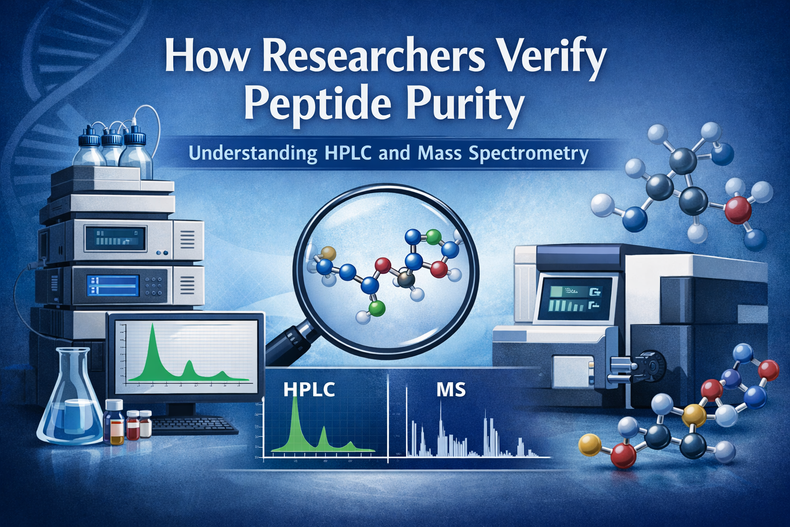
As molecules leave the column, a detector measures them and creates a graph called a chromatogram.
Understanding the HPLC Chromatogram
The chromatogram shows peaks on a graph.
Each peak represents a different compound.
Researchers analyze the graph like this:
-
a large main peak usually represents the target peptide
-
smaller peaks represent impurities
Scientists calculate purity by comparing the area of the main peak to the total area of all peaks.
Example:
If the main peak represents 98% of the total signal, the peptide purity is about 98%.
For most research purposes, peptides with 95% or higher purity are considered good quality.
Reversed-Phase HPLC: The Gold Standard
The most common version used for peptides is Reversed-Phase HPLC (RP-HPLC).
In RP-HPLC:
-
the column repels water
-
peptides interact with the column differently depending on their structure
More hydrophobic peptides stick longer to the column and exit later.
This separation allows researchers to detect even tiny impurities.
Because it is accurate and sensitive, RP-HPLC is considered the gold standard for peptide purity testing.
Mass Spectrometry: Confirming the Peptide Identity
While HPLC measures purity, Mass Spectrometry (MS) confirms the identity of the peptide.
Mass spectrometry measures the molecular weight of molecules.
Every peptide has a unique molecular weight based on its amino acid sequence.
If the measured weight matches the expected weight, the peptide is confirmed.
How Mass Spectrometry Works
Mass spectrometry works through several steps.
-
The peptide molecules are converted into charged particles called ions.
-
These ions pass through an analyzer inside the instrument.
-
The analyzer measures their mass-to-charge ratio (m/z).
-
The results are displayed as a mass spectrum graph.
From this graph, scientists can calculate the exact molecular weight of the peptide.
What Mass Spectrometry Can Reveal
Mass spectrometry helps researchers detect many important things.
It can show:
-
whether the peptide has the correct molecular weight
-
if amino acids are missing
-
if the peptide contains unexpected modifications
-
whether there are shorter fragments present
This makes mass spectrometry a powerful tool for confirming peptide identity.
Common Ionization Methods
Two methods are commonly used to ionize peptides in mass spectrometry.
Electrospray Ionization (ESI)
In this method:
-
the peptide solution is sprayed through a charged needle
-
molecules become ionized in a gentle process
ESI works well for large and fragile molecules.
It is often combined with HPLC in a system called LC-MS.
MALDI (Matrix-Assisted Laser Desorption/Ionization)
In MALDI:
-
the sample is mixed with a special matrix
-
a laser pulse ionizes the molecules
MALDI is fast and useful for screening many samples quickly.
Why HPLC and Mass Spectrometry Are Used Together
Neither method gives the full picture alone.
Each method answers a different question.
| Method | What It Shows |
|---|---|
| HPLC | How pure the sample is |
| Mass Spectrometry | Whether the peptide structure is correct |
When combined, scientists get a complete analysis of the peptide sample.
This combination is known as LC-MS, and it is widely used in pharmaceutical research.
Common Impurities Found in Peptides
Even experienced laboratories sometimes detect impurities.
Some common ones include:
Deletion sequences
Amino acids missing during synthesis.
Truncated peptides
Incomplete chains that stopped growing early.
Oxidized methionine
Oxidation adds extra mass to the peptide.
Deamidation
Chemical changes in asparagine or glutamine residues.
TFA adducts
Trifluoroacetic acid used in HPLC can attach to peptides.
Peptide dimers or aggregates
Peptides sometimes stick together.
Identifying these impurities helps improve both synthesis quality and research accuracy.
Typical Peptide Purity Levels
The required purity level depends on the research purpose.
Here is a general guide.
| Application | Typical Purity Requirement |
|---|---|
| Early research | 70–75% |
| Cell experiments | 85–90% |
| Animal studies | 95% |
| Clinical research | 98–99% |
Higher purity usually means more reliable experimental results.
Challenges in Peptide Purity Testing
Even advanced tools have limitations.
Some challenges include:
-
very similar impurities that are hard to separate
-
peptides that ionize poorly in MS
-
aggregation of hydrophobic peptides
-
unstable peptides that degrade during testing
To solve these problems, scientists may adjust testing conditions or use additional analytical methods.
Real-World Applications of Peptide Testing
Peptide purity testing plays an important role in many areas.
Drug Development
Peptide drugs such as semaglutide must meet strict purity standards before human testing.
Vaccine Research
Synthetic peptides are used as antigens. Pure peptides create more reliable immune responses.
Proteomics
Reference peptides help calibrate instruments used to analyze proteins.
Diagnostics
Peptides used in diagnostic tests must be highly pure to avoid false results.
Conclusion
Peptide purity testing is a critical part of modern scientific research.
Without proper testing, even well-designed experiments can produce unreliable results.
Two powerful technologies make this possible:
-
HPLC, which measures how pure the sample is
-
Mass Spectrometry, which confirms the peptide's identity
Together, these methods give researchers confidence in their materials and their data.
As peptide-based medicines and therapies continue to grow, the importance of accurate peptide purity testing will only increase.
For scientists, clinicians, and students working with peptides, understanding these tools is essential.
Because in science, knowing exactly what you are working with is the first step toward meaningful discovery.