
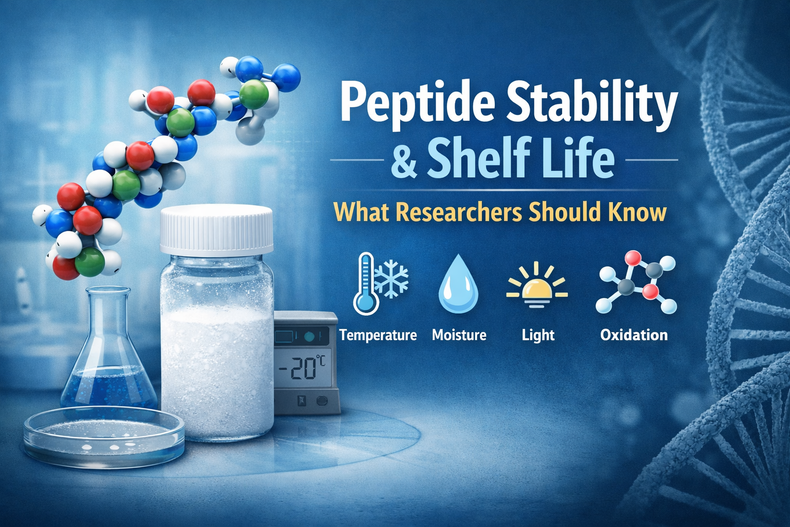
How to Keep Your Research Peptides Potent, Accurate, and Reliable, Every Single Time
Your peptide sample looked perfect when it arrived. The purity certificate was solid. The vial was sealed. You stored it carefully.
But three weeks later, your results don't make sense. Your dose-response curve is flat. Your binding data is all over the place. You run the experiment again, same problem.
Sound familiar?
In most cases like this, the peptide is the culprit. Not your technique. Not your cells. The peptide quietly degraded before you ever used it, and you had no idea.
This is exactly why peptide stability research matters so much. Understanding how peptides break down, what speeds up that process, and how to stop it can save your experiment, your timeline, and your budget.
This guide covers everything you need to know, in plain, simple language that's easy to read and even easier to apply in your lab.
Quick Reference: What Every Researcher Should Know
Before we go deep, here's the short version:
- Peptides break down from heat, moisture, light, oxygen, and pH changes
- Lyophilized (dry powder) peptides last much longer than dissolved ones
- Store at -20°C or colder for long-term use, colder is always better
- Never refreeze a thawed solution - use single-use aliquots instead
- Let cold vials warm to room temperature before opening to avoid moisture damage
- Watch for cloudiness, color changes, or inconsistent results, these signal degradation
- When in doubt about a peptide's quality, order fresh, it's cheaper than a failed experiment
What Is Peptide Stability in Research?
Peptide stability in research simply means how well a peptide holds its structure, purity, and biological activity over time.
Peptides are chains of amino acids connected by chemical bonds. Those bonds are strong, but not invincible. When exposed to the wrong conditions, the bonds break, the structure changes, and the peptide stops working the way it should.
Think of it like fresh bread. Baked fresh, it's perfect. Leave it exposed to air and moisture for a few days, and something has clearly gone wrong, even though the ingredients are the same.
In peptide stability research, scientists study exactly when and how these changes happen, and what conditions protect against them. That knowledge directly impacts the quality of every experiment the peptide is used in.
Why Peptide Stability Matters So Much
If your peptide is not stable, your research cannot be trusted. It's that simple.
Here's what's actually at stake:
Your results. A degraded peptide gives unreliable, inconsistent, or completely wrong data. What looks like a biological effect may just be an artifact of a broken-down molecule.
Your costs. Research-grade peptides are expensive. Poor storage turns a high-quality purchase into wasted money.
Your reproducibility. If another lab, or even your own lab six months later, tries to repeat your work using a fresh peptide, the results won't match. That's a serious problem for any research program.
Your safety. In cell studies and animal experiments, degraded peptides can behave in unexpected ways, introducing variables you never accounted for.
Why Do Peptides Break Down?
Several things can cause a peptide to degrade. Knowing what they are helps you prevent them.
Water (Hydrolysis)
Water molecules can attack and split peptide bonds, a process called hydrolysis. This is one of the most common degradation pathways, especially when peptides are stored in solution for extended periods. Even small amounts of moisture in a "dry" vial can trigger this process.
Oxygen (Oxidation)
Certain amino acids are especially sensitive to oxygen exposure. Methionine, cysteine, and tryptophan can oxidize when exposed to air, which changes the peptide's structure and often destroys its activity completely. Peptides containing any of these amino acids need extra care during storage and handling.
Heat
Higher temperatures speed up every chemical reaction, including the ones that break peptides apart. This is why temperature control is so critical in peptide stability research. Even sitting at room temperature for a few days can degrade a sensitive peptide enough to affect your results.
Light (Photodegradation)
UV light can damage specific amino acids, particularly tryptophan and tyrosine. Storing peptides in clear vials under bright lab lighting is a common, and costly mistake. Always use amber vials or wrap clear vials in foil.
pH Extremes
Peptides have a stability sweet spot for pH. Too acidic or too basic, and the chemical structure can change. When choosing a reconstitution solvent or buffer, pH compatibility matters as much as solubility.
Enzymes (Proteolysis)
Proteases are enzymes that cut proteins and peptides apart. If a peptide comes into contact with biological samples, cell lysates, or certain buffers that contain protease activity, it can be rapidly degraded. This is especially relevant for in vivo studies where blood and tissue enzymes are always present.
Lyophilized vs. Reconstituted Peptides: A Critical Difference
The form your peptide is in has a massive effect on how long it stays stable.
Lyophilized (freeze-dried) peptides are the dry powder form. Because there's no water present, hydrolysis can't happen. This makes lyophilized peptides far more stable and much easier to store long-term. Most can last one to two years or more at -20°C when kept properly sealed and dry.
Reconstituted peptides those dissolved in a solvent, are a different story. Once you add liquid, the clock starts ticking. The peptide is now vulnerable to hydrolysis, bacterial contamination, and temperature fluctuation. Most reconstituted solutions should be used within days to a few weeks, depending on the peptide and storage conditions.
The rule of thumb: Keep peptides in their lyophilized form until you actually need them. Reconstitute only what you'll use, and freeze the rest in small aliquots immediately.
Peptide Shelf Life: What to Expect
Here's a practical breakdown of expected shelf life based on form and storage temperature:
| Form | Storage Temp | Expected Shelf Life |
|---|---|---|
| Lyophilized powder | -20°C | 1–2 years |
| Lyophilized powder | 4°C (fridge) | Several months |
| Reconstituted solution | -20°C (aliquoted) | Weeks to a few months |
| Reconstituted solution | 4°C (fridge) | Days to 2–3 weeks |
| Reconstituted solution | Room temperature | Hours to 1–2 days max |
Always check your supplier's documentation for peptide-specific guidance, especially for sequences containing oxidation-prone or unusual amino acids.
Best Storage Practices for Maximum Peptide Stability
This is where peptide stability research meets real lab practice. Follow these steps consistently and your samples will perform the way they're supposed to.
Keep It Cold
Store lyophilized peptides at -20°C for routine use, or -80°C for very sensitive peptides or long-term storage. Never leave peptides at room temperature for extended periods, even a few hours can matter for sensitive sequences.
Use Single-Use Aliquots
Every time you freeze and thaw a peptide solution, you stress it. Ice crystals form. Concentration gradients shift. Oxidation increases.
The fix is simple: right after reconstituting, divide the solution into small, single-use portions before freezing. Use one aliquot, then discard it. Never refreeze a thawed aliquot.
Let Cold Vials Warm Up Before Opening
This is one of the most overlooked rules in peptide handling. When you pull a cold vial out of a freezer, condensation from the air will form inside the vial if you open it immediately. That moisture can start degrading a lyophilized peptide within minutes.
Always let the sealed vial come to room temperature first, then open it.
Protect From Light
Use amber-colored vials when possible, or wrap clear vials in aluminum foil. This is especially important for peptides containing tryptophan or tyrosine.
Minimize Oxygen Exposure
For peptides with methionine, cysteine, or tryptophan, consider purging your vials with nitrogen or argon before sealing. Work quickly when the vial is open, and keep reconstituted solutions in tightly sealed containers.
Use Airtight, Low-Binding Containers
Standard plastic tubes can sometimes bind peptides, especially at very low concentrations. Use low-binding tubes, keep vials airtight, and store with a desiccant (a moisture absorber) in the freezer bag or container.
Choose the Right Reconstitution Solvent
This matters more than most researchers realize. Using the wrong solvent can cause immediate aggregation or degradation. General starting points:
- Water-soluble peptides: sterile water or PBS
- Hydrophobic peptides: start with a small amount of DMSO or acetonitrile, then dilute with water
- Positively charged peptides: dilute acetic acid (0.1–1%) often helps
- Negatively charged peptides: dilute ammonium bicarbonate or ammonia solution
Always check the supplier's recommendation for your specific peptide before reconstituting.
The Wrong Way vs. The Right Way
Here's a real-world scenario that shows how quickly things can go wrong, and how easy it is to do it right.
The wrong way:
You get a new peptide. You reconstitute the entire vial at once into a single tube. You use what you need that day, then pop the rest in the fridge. Over the next two weeks, you open the same tube seven times. Your last experiment gives you inconsistent results and you can't figure out why.
What actually happened:
Each time you opened that tube, moisture and oxygen entered. The repeated exposure gradually oxidized the methionine-containing residues. By experiment three or four, you were working with a partially degraded peptide and didn't know it.
The right way:
Reconstitute the amount you need for one or two experiments. Divide it into small single-use aliquots immediately. Freeze them at -20°C. Pull one aliquot per experiment, use it completely, and discard it. Your peptide stays stable across the entire series.
The result: Consistent, reproducible data from the first experiment to the last.
Common Mistakes That Shorten Peptide Shelf Life
Even experienced researchers make these mistakes. Knowing them is the first step to avoiding them.
Storing dissolved peptides at 4°C for too long. The fridge is convenient, but a few weeks in solution at 4°C is often enough to significantly reduce peptide activity, especially for sensitive sequences.
Opening a cold vial immediately. Condensation forms inside the vial and introduces moisture. Always let it reach room temperature first.
Skipping aliquots. It feels like extra work, but it's the single most effective protective step you can take for any peptide you plan to use more than once.
Using contaminated or unstable solvents. Old, partially evaporated DMSO or bacterially contaminated water can directly damage a peptide during reconstitution.
Not documenting storage conditions. If your results look off, your notes are how you trace the problem. Always record when a peptide was received, when it was reconstituted, the batch number, and how it was stored.
Ignoring freezer failures. A freezer malfunction overnight can be enough to compromise months of stored peptides. If you have any doubt about whether temperature was maintained, treat those samples as suspect.
How Researchers Test Peptide Stability
Knowing storage best practices is one thing. Actually measuring whether your peptide is still good is another. In serious peptide stability research, these are the main tools used:
HPLC (High-Performance Liquid Chromatography)
This is the gold standard for purity testing. HPLC can detect small amounts of degradation products and tell you exactly what percentage of your sample is still intact. A good research-grade peptide should start at 95%+ purity. If it drops below 90%, results can become unreliable.
Mass Spectrometry (MS)
Mass spec identifies the exact molecular weight of a peptide. It can catch chemical changes like oxidation or deamidation even when the peptide appears fine visually or by other measures. It's especially useful for detecting subtle modifications that HPLC alone might miss.
UV Absorbance
A quick method to check peptide concentration, though it doesn't measure purity on its own. Useful as a fast check, but not a replacement for HPLC.
Circular Dichroism (CD)
CD measures secondary structure, alpha-helices, beta-sheets, and other three-dimensional shapes. When a peptide's function depends on its specific shape, CD can confirm whether that structure is still intact after storage.
Peptide Stability Across Different Research Applications
The stakes of peptide stability change depending on what you're doing.
Cell-based assays: Even a small drop in purity can produce very different results. A peptide at 80% purity may show a completely different activity profile than the same peptide at 98%. If your controls are off, stability should be the first thing you check.
Receptor binding studies: Slight structural changes from oxidation or hydrolysis can dramatically reduce binding affinity. This makes your dose-response data unreliable and your IC50 calculations meaningless.
Animal studies: In vivo, peptides face additional challenges beyond the lab. Proteases in the bloodstream can rapidly degrade them. Researchers working with in vivo models often use modified peptides, such as those with D-amino acids, cyclization, or PEGylation, specifically to improve stability in biological environments.
Long-running experiments: If your study spans months, the peptide used in month one needs to perform identically to the one used in month six. That only happens with consistent, disciplined storage and documentation throughout.
When to Replace Your Peptide Sample
These are the signs that it's time to order fresh:
- Your results are inconsistent or impossible to reproduce
- HPLC purity has dropped below 90–95%
- The solution has changed color, turned cloudy, or developed visible particles
- You've gone through several freeze-thaw cycles on the same aliquot
- You've exceeded the recommended storage time
- You can't confirm the storage conditions were maintained, for example, after a freezer failure
- Your positive control is no longer responding as expected
When any of these apply, fresh peptide is almost always the right call. The cost of a new sample is far less than the cost of running a flawed experiment, or worse, publishing results built on degraded data.
Final Thoughts
Peptide stability isn't just a storage problem, it's a science problem. The quality of your peptide directly shapes the quality of your data.
The good news is that most stability problems are completely preventable. Keep it cold. Keep it dry. Keep it dark. Minimize oxygen exposure. Aliquot before freezing. Document everything.
These aren't complicated steps. But researchers who follow them consistently get results they can trust, and researchers who don't often spend weeks chasing problems that were sitting in their freezer the whole time.
Better peptide stability research starts with better habits. And better habits start here.
Looking for high-purity, research-grade peptides with complete documentation? TheraTideUSA.com provides verified lyophilized peptides built for researchers who need results they can stand behind.