
Introduction
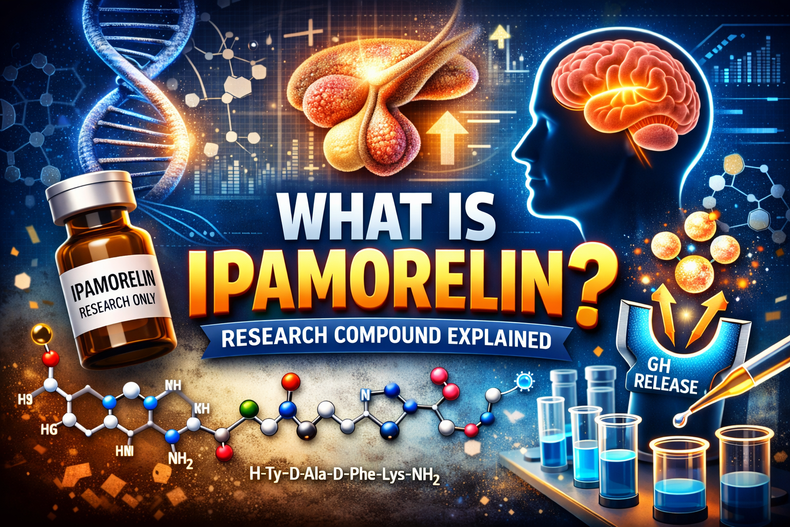
Ipamorelin is a synthetic research peptide that has attracted attention in studies focused on growth hormone (GH) signaling.
Many people searching “what is ipamorelin” want a clear, science-based explanation—without hype, marketing claims, or medical promises.
This article explains ipamorelin strictly from a research perspective.
Short sentences. Simple words. Clean structure.
Easy to read from start to finish.
Table of Contents
-
What Is Ipamorelin?
-
How Does Ipamorelin Work?
-
Why Researchers Study Ipamorelin
-
Areas Explored in Research
-
Ipamorelin vs Other GHRPs
-
Current Research Status
-
Safety & Research-Only Disclaimer
-
Key Takeaways
-
Frequently Asked Questions
1. What Is Ipamorelin?
Ipamorelin is a synthetic pentapeptide.
That means it contains five amino acids linked together.
It belongs to a group of compounds called growth hormone-releasing peptides (GHRPs).
In simple terms:
Ipamorelin is a research peptide designed to stimulate growth hormone release in a selective way.
It was developed after earlier GHRPs such as GHRP-2 and GHRP-6.
Researchers found ipamorelin to be more selective, meaning it focuses mainly on growth hormone without strongly affecting other hormones.
Important clarification:
-
Ipamorelin is not a drug
-
It is not a supplement
-
It is not approved for human or animal use
It exists only for laboratory research.
2. How Does Ipamorelin Work?
To understand ipamorelin, you need to understand one key receptor.
The Ghrelin (GHS-R) Receptor
The body produces a natural hormone called ghrelin.
Ghrelin signals the pituitary gland to release growth hormone.
Ipamorelin mimics this action.
In research models:
-
Ipamorelin binds to the growth hormone secretagogue receptor (GHS-R)
-
This triggers a pulse of growth hormone release
-
The effect is considered selective
Unlike some older GHRPs, ipamorelin shows minimal stimulation of cortisol and prolactin pathways in studies.
Step-by-Step Mechanism (Observed in Research)
| Step | What Happens | Where |
|---|---|---|
| 1 | Ipamorelin binds to GHS-R | Pituitary & hypothalamus |
| 2 | Cellular signaling activates | Somatotroph cells |
| 3 | Growth hormone is released | Pituitary gland |
| 4 | GH circulates in bloodstream | Systemic circulation |
| 5 | IGF-1 production increases | Liver |
This controlled signaling pattern is one reason ipamorelin is useful in research.
3. Why Researchers Study Ipamorelin
Scientists study ipamorelin to better understand:
-
Growth hormone regulation
-
Hormone pulse timing
-
Receptor-specific signaling
-
Differences between GH secretagogues
Because of its focused activity, ipamorelin is often used as a clean research tool for studying GH pathways.
4. Areas Explored in Research
Ipamorelin has not been approved for medical use.
Most data comes from animal and preclinical studies.
Body Composition
Some studies in animal models observed:
-
Increased lean mass
-
Reduced fat mass
These effects are linked to downstream GH and IGF-1 activity.
Bone Density
Early research in rodents explored:
-
Bone mineral content
-
Skeletal remodeling
This made ipamorelin a point of interest in aging-related bone research.
Tissue Repair & Recovery
Growth hormone plays a role in tissue repair.
Researchers explored whether GH pulses stimulated by ipamorelin affected:
-
Muscle recovery
-
Connective tissue models
Gastrointestinal Motility
One unique research area involves the gut.
Ipamorelin was studied for its effects on:
-
Bowel movement signaling
-
Postoperative ileus models
Some human trials were once conducted in this area, but development was discontinued.
Sleep-Related GH Patterns
GH release is naturally higher during deep sleep.
Some researchers hypothesized that GH stimulation might influence sleep architecture.
This remains an early and exploratory area.
5. Ipamorelin vs Other GHRPs
Researchers often compare GHRPs to understand differences.
| Compound | GH Release | Cortisol | Prolactin | Selectivity |
|---|---|---|---|---|
| Ipamorelin | Moderate–Strong | Minimal | Minimal | High |
| GHRP-2 | Strong | Moderate | Moderate | Moderate |
| GHRP-6 | Strong | Moderate | Moderate | Moderate |
| Hexarelin | Very Strong | Higher | Higher | Lower |
Ipamorelin’s defining feature in research is its selectivity.
6. Current Research Status
Ipamorelin was once developed under the name NNC 26-0161.
Limited human studies were conducted, mainly for gastrointestinal research.
Clinical development was later stopped.
Today:
-
Ipamorelin is not FDA approved
-
It is not approved by EMA
-
It remains a research-only compound
It is often discussed alongside other research peptides such as CJC-1295 in GH-axis studies.
7. Safety & Research-Only Disclaimer
Ipamorelin does not have an established human safety profile.
In animal research:
-
It was generally well tolerated
-
Some effects linked to GH elevation were observed
Long-term human effects are unknown.
Ipamorelin is for laboratory research only.
Not for human or animal consumption.
Key Takeaways
-
Ipamorelin is a synthetic pentapeptide
-
It is classified as a growth hormone secretagogue
-
It acts on ghrelin (GHS-R) receptors
-
It is considered highly selective in research
-
Studies focus on GH signaling, body composition, bone, and gut motility
-
It is not FDA approved
-
Most data comes from animal studies
Frequently Asked Questions
What is ipamorelin used for?
Ipamorelin is used only in scientific research to study growth hormone regulation.
Is ipamorelin the same as HGH?
No. HGH is the hormone itself.
Ipamorelin stimulates the body’s own GH release in research models.
Why is ipamorelin considered selective?
It mainly stimulates GH release without strongly affecting cortisol or prolactin pathways.
How is ipamorelin different from sermorelin?
Sermorelin acts on GHRH receptors.
Ipamorelin acts on ghrelin receptors.
They work through different pathways.
Is ipamorelin FDA approved?
No. It is not approved for human use.
Why is ipamorelin paired with CJC-1295 in research?
They activate different receptors.
Researchers study them together to observe synergistic GH signaling.
Final Disclaimer
This article is published by TheraTide USA for educational and informational purposes only.
Ipamorelin is a research compound and is not approved for human or animal use.
Nothing on this page constitutes medical advice, diagnosis, or treatment.