
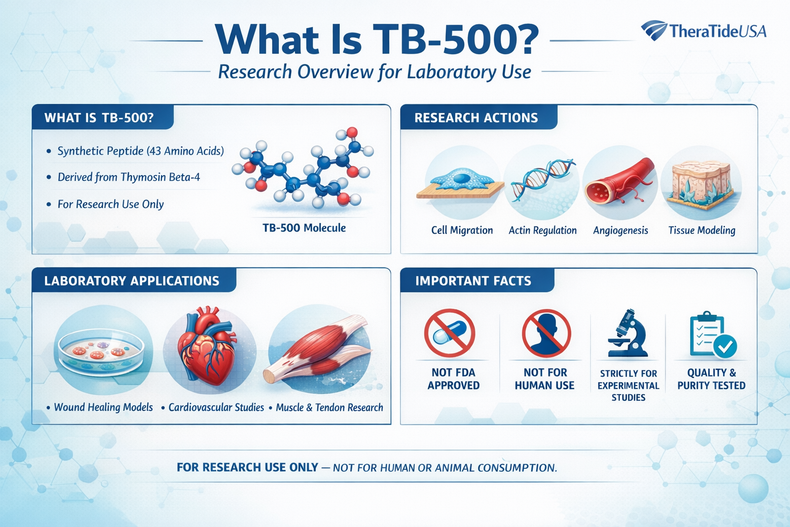
TB-500 is a synthetic peptide derived from Thymosin Beta-4, a naturally occurring protein that plays essential roles in cellular processes including tissue repair, inflammation modulation, and cell migration. In laboratory settings, TB-500 has emerged as a valuable research tool for investigating wound healing mechanisms, vascular development, and regenerative pathways.
Molecular Structure and Composition
TB-500 represents a synthetic analog of the active region of Thymosin Beta-4 (Tβ4), a 43-amino acid protein found in virtually all mammalian cells except red blood cells. While the full Tβ4 molecule contains 43 amino acids, TB-500 is typically composed of a shortened sequence that retains the biologically active portions.
Understanding Thymosin Beta-4
Thymosin Beta-4 was first isolated from the thymus gland in the 1960s and has since been identified as one of the most abundant proteins in mammalian cells. It plays crucial roles in cellular organization, wound healing, and immune function. TB-500 replicates the key functional domains responsible for these biological activities.
Key Molecular Characteristics
- Molecular Weight: Approximately 4.9 kDa (kilodaltons)
- Sequence Length: Typically 43 amino acids for full-length variants
- Structural Motif: Contains actin-binding domain responsible for primary biological effects
- Stability: Highly stable in lyophilized form; requires refrigeration when reconstituted
- Solubility: Water-soluble peptide suitable for subcutaneous or intramuscular administration in research models
Research Note
The actin-binding properties of TB-500 are central to its biological effects. By sequestering monomeric actin, TB-500 influences cytoskeletal dynamics, which affects cell migration, differentiation, and tissue remodeling—processes critical in wound healing and development.
Biological Mechanisms of Action
The biological activities of TB-500 are mediated through multiple cellular pathways, making it a compound of interest for diverse research applications. Understanding these mechanisms is essential for designing appropriate laboratory protocols.
Primary Mechanisms
1. Actin Sequestration and Cytoskeletal Regulation
TB-500's primary mechanism involves binding to monomeric G-actin, preventing its polymerization into F-actin filaments. This regulation of the actin cytoskeleton influences:
- Cell motility and migration
- Cell shape and structure maintenance
- Intracellular trafficking and organization
- Tissue remodeling during repair processes
2. Promotion of Angiogenesis
Laboratory studies have demonstrated that TB-500 promotes new blood vessel formation through:
- Enhanced endothelial cell migration
- Upregulation of vascular endothelial growth factor (VEGF) pathways
- Stimulation of vascular sprouting in tissue models
- Improved blood flow to healing tissues in animal studies
3. Anti-Inflammatory Effects
Research indicates TB-500 modulates inflammatory responses by:
- Reducing levels of pro-inflammatory cytokines
- Decreasing chemokine production at injury sites
- Modulating macrophage activity
- Promoting resolution of inflammatory processes
4. Cell Migration and Tissue Repair
TB-500 facilitates tissue repair through multiple pathways:
- Enhanced migration of keratinocytes in wound models
- Increased differentiation of stem cell populations
- Promotion of extracellular matrix remodeling
- Acceleration of epithelialization processes
Research Applications in Laboratory Studies
TB-500 has been investigated across multiple research domains, providing insights into fundamental biological processes and potential therapeutic approaches. Here are the primary areas of investigation:
Wound Healing Research
TB-500 is extensively studied in wound healing models, where it has demonstrated effects on various healing stages:
- Accelerated closure rates in dermal wound models
- Enhanced epithelial migration and proliferation
- Improved granulation tissue formation
- Reduced scar tissue formation in some experimental settings
- Promotion of hair follicle regeneration in wound beds
Cardiovascular Research
Laboratory investigations have explored TB-500's effects on cardiovascular tissues:
- Protection against ischemic injury in cardiac tissue models
- Promotion of coronary vessel formation
- Potential cardioprotective effects in myocardial infarction models
- Enhanced cardiac progenitor cell survival and migration
- Modulation of fibrosis in heart tissue
Notable Study
Research published in cardiovascular journals has demonstrated that TB-500 administration following experimental myocardial infarction resulted in improved cardiac function, reduced infarct size, and enhanced neovascularization in animal models. These findings have spurred continued investigation into its cardiovascular applications.
Musculoskeletal Research
TB-500 is investigated for its effects on various musculoskeletal tissues:
- Enhanced muscle fiber regeneration after injury
- Promotion of satellite cell activation and proliferation
- Potential benefits in tendon and ligament healing models
- Effects on bone healing and remodeling
- Reduction of fibrosis in injured muscle tissue
Neurological Research
Emerging research explores TB-500's potential neuroprotective properties:
- Promotion of neural cell migration and differentiation
- Potential neuroprotective effects in injury models
- Enhancement of neurite outgrowth in culture systems
- Modulation of neuroinflammatory responses
- Investigation in central nervous system injury models
Stem Cell and Regenerative Medicine
TB-500 is being investigated as a tool in regenerative research:
- Effects on mesenchymal stem cell migration and homing
- Enhancement of stem cell survival in hostile environments
- Promotion of directed differentiation in specific tissue types
- Potential synergistic effects when combined with other growth factors
TB-500 vs BPC-157: Comparative Analysis
Both TB-500 and BPC-157 are peptides investigated in regenerative research, but they differ significantly in origin, structure, and mechanisms. Understanding these differences is crucial for researchers selecting appropriate compounds for specific investigations.
TB-500: Origins and Mechanisms
- Origin: Synthetic analog of naturally occurring Thymosin Beta-4
- Primary Mechanism: Actin binding and cytoskeletal regulation
- Key Effects: Angiogenesis promotion, cell migration, anti-inflammatory properties
- Research Focus: Cardiovascular health, wound healing, musculoskeletal repair
- Distribution: Systemic effects due to widespread cellular presence of actin
BPC-157: Origins and Mechanisms
- Origin: Synthetic peptide derived from a protective gastric protein
- Primary Mechanism: Modulation of growth factor expression (VEGF, FGF, EGF)
- Key Effects: Gastrointestinal protection, tendon/ligament healing, vascular regulation
- Research Focus: Digestive system protection, connective tissue repair, vascular health
- Distribution: Particularly effective in gastrointestinal and vascular research
Key Differences in Research Applications
Mechanism of Action: TB-500 primarily works through actin regulation, affecting fundamental cellular processes across many tissue types. BPC-157 operates mainly through growth factor pathway modulation, with particular strength in vascular and connective tissue research.
Tissue Specificity: TB-500 demonstrates broad applicability due to actin's ubiquitous cellular presence, making it valuable for diverse tissue types. BPC-157 shows particular efficacy in gastrointestinal, tendon, and ligament research models.
Research Evidence Base: TB-500 benefits from decades of research on its parent molecule, Thymosin Beta-4, with extensive documentation in peer-reviewed literature. BPC-157 has a more concentrated body of research, primarily from specific research groups.
Combination Potential: Some researchers investigate combined protocols leveraging both peptides' complementary mechanisms, though this remains an area of active investigation.
Laboratory Dosing Protocols
Establishing appropriate dosing protocols is critical for reproducible research results. Dosing strategies vary considerably based on research model, species, and specific endpoints being measured.
General Dosing Considerations in Research
Loading Phase vs Maintenance Phase: Many research protocols distinguish between initial loading doses designed to achieve tissue saturation and lower maintenance doses for sustained effects.
Frequency of Administration: Research protocols typically employ twice-weekly to daily administration depending on the model and endpoints:
- Acute injury models: Daily administration during initial healing phase
- Chronic condition models: 2-3 times per week for extended periods
- In vitro studies: Continuous presence in culture media or periodic additions
Species-Specific Dosing Ranges
Rodent Models (Mice and Rats)
- Dosage Range: 0.1 - 10 mg/kg body weight
- Common Protocol: 1-5 mg/kg administered 2-3 times per week
- Administration Route: Subcutaneous or intraperitoneal injection
- Duration: Typically 2-6 weeks depending on model
Large Animal Models
- Dosage Range: 0.5 - 20 mg per dose (dose not weight-normalized)
- Common Protocol: 5-10 mg twice weekly
- Administration Route: Subcutaneous or intramuscular injection
- Duration: 4-12 weeks in published studies
In Vitro Studies
- Concentration Range: 1-100 ng/mL in culture media
- Common Protocol: 10-50 ng/mL continuous exposure or periodic addition
- Application: Added directly to culture media or coating matrices
- Duration: Varies from hours to days depending on assay
Reconstitution and Storage
Proper handling is essential for maintaining TB-500 stability and biological activity:
- Lyophilized Storage: Store at -20°C or below until reconstitution
- Reconstitution: Use sterile bacteriostatic water or saline; gentle mixing without vigorous shaking
- Reconstituted Storage: Refrigerate at 2-8°C and use within 7-14 days
- Freeze-Thaw Cycles: Minimize to prevent degradation; single-use aliquots recommended
- Light Protection: Protect from direct light exposure when possible
Safety Profile and Considerations
Understanding the safety profile of TB-500 in laboratory settings is essential for proper experimental design and risk assessment. The majority of safety data comes from animal studies and limited clinical observations.
Observed Safety in Animal Studies
Published research suggests TB-500 is generally well-tolerated in laboratory animal models:
- Minimal adverse effects reported in rodent studies at standard research doses
- Good tolerability in large animal models including equine and canine studies
- No significant hepatotoxicity or nephrotoxicity in toxicology assessments
- Limited immunogenic responses in most models
Theoretical Concerns and Research Limitations
Angiogenesis and Cancer Research
Because TB-500 promotes angiogenesis, theoretical concerns exist regarding its use in contexts involving malignancy. While research has not demonstrated that TB-500 initiates tumorigenesis, its angiogenic properties could potentially support existing tumor growth. This remains an area requiring further investigation.
Considerations for Research Design
- Control Groups: Always include appropriate vehicle controls
- Dose-Response Studies: Establish optimal dosing for specific endpoints
- Duration Considerations: Long-term effects beyond typical study durations remain incompletely characterized
- Combination Studies: Exercise caution when combining with other bioactive compounds
- Endpoint Monitoring: Include comprehensive safety endpoints beyond primary efficacy measures
Regulatory Status
Current Research and Future Directions
The research landscape for TB-500 continues to evolve, with ongoing investigations exploring new applications and mechanisms. Understanding current research trends helps contextualize the peptide's potential and limitations.
Active Research Areas
Cardiac Regeneration: Ongoing studies investigate TB-500's potential in promoting cardiac repair following myocardial infarction. Research focuses on its ability to mobilize cardiac progenitor cells, promote angiogenesis, and reduce fibrotic remodeling. Several research groups are exploring its mechanisms in protecting cardiomyocytes from ischemic injury.
Neural Repair and Neuroprotection: Emerging evidence suggests TB-500 may cross the blood-brain barrier and exert neuroprotective effects. Current research explores its potential in models of stroke, traumatic brain injury, and neurodegenerative conditions, focusing on its anti-inflammatory and regenerative properties in neural tissue.
Diabetic Wound Healing: The impaired wound healing characteristic of diabetes has prompted research into TB-500's potential in diabetic models. Studies investigate whether its angiogenic and anti-inflammatory properties can overcome the healing deficits associated with diabetic pathophysiology.
Dry Eye and Corneal Injury: Ophthalmic research has examined topical TB-500 application for corneal wound healing and dry eye treatment. The peptide's ability to promote epithelial migration makes it an interesting candidate for ocular surface disorders.
Mechanistic Research Priorities
Fundamental questions remain about TB-500's mechanisms of action:
- Precise molecular pathways mediating angiogenic effects
- Interaction with specific cell surface receptors or intracellular targets
- Differential effects across tissue types and physiological contexts
- Synergistic or antagonistic interactions with other signaling pathways
- Long-term effects on tissue remodeling and function
Challenges and Limitations
Several challenges face TB-500 research:
- Translation to Humans: Most data derives from animal models; human applicability requires validation
- Optimal Dosing: Significant variability exists in research protocols, making cross-study comparisons difficult
- Long-Term Effects: Limited data on extended administration periods and prolonged outcomes
- Mechanistic Gaps: Incomplete understanding of all molecular mechanisms limits targeted application
- Standardization: Variability in peptide purity and formulation across suppliers affects reproducibility
Key Research Takeaways
- TB-500 is a synthetic peptide based on Thymosin Beta-4, affecting cellular processes through actin binding and cytoskeletal regulation
- Primary research applications include wound healing, cardiovascular repair, musculoskeletal regeneration, and angiogenesis studies
- The peptide demonstrates good tolerability in animal models with minimal reported adverse effects at standard research doses
- TB-500 and BPC-157 have distinct mechanisms and tissue specificities, though both show regenerative properties in laboratory research
- Current research explores cardiac regeneration, neuroprotection, diabetic wound healing, and corneal repair applications
- Significant mechanistic questions remain, and translation of animal research to human applications requires further validation
- TB-500 is designated for research use only and is not approved for human therapeutic applications
Conclusion
TB-500 represents a valuable tool in regenerative medicine research, offering insights into fundamental processes of wound healing, angiogenesis, and tissue repair. Its derivation from the naturally occurring Thymosin Beta-4 protein provides a biological foundation for its observed effects, while its synthetic production allows for standardized research applications.
The peptide's mechanisms—primarily centered on actin regulation and cytoskeletal dynamics—affect diverse cellular processes across multiple tissue types. This broad biological activity has made TB-500 a subject of investigation in cardiovascular research, wound healing studies, musculoskeletal repair models, and emerging areas like neuroprotection and corneal healing.
For researchers considering TB-500 in laboratory protocols, several considerations are paramount: proper experimental design with appropriate controls, adherence to established dosing ranges from published literature, recognition of species-specific differences in response, and acknowledgment of current mechanistic gaps. The peptide's safety profile in animal studies appears favorable, though long-term effects and potential concerns related to its angiogenic properties warrant continued investigation.
While TB-500 has demonstrated promising results across multiple research domains, substantial work remains before its mechanisms are fully elucidated and its potential applications are completely understood. The peptide continues to serve as both a research tool for understanding fundamental biological processes and a candidate molecule for future therapeutic development, always within the context of rigorous scientific investigation and regulatory compliance.
High-Quality Research Peptides for Your Laboratory
TheraTideUSA provides research-grade peptides with comprehensive purity documentation, proper handling protocols, and expert technical support for laboratory investigations.
Explore Research PeptidesDisclaimer: This article is provided for educational and informational purposes only. TB-500 is intended solely for laboratory research use and is not approved for human consumption or therapeutic use by the FDA or other regulatory agencies. The information presented does not constitute medical advice, and should not be interpreted as recommendations for human use. Researchers must comply with all applicable regulations, obtain necessary approvals from institutional review boards, and follow established safety protocols. TheraTideUSA does not endorse or support the use of research peptides outside of legitimate laboratory research contexts.