
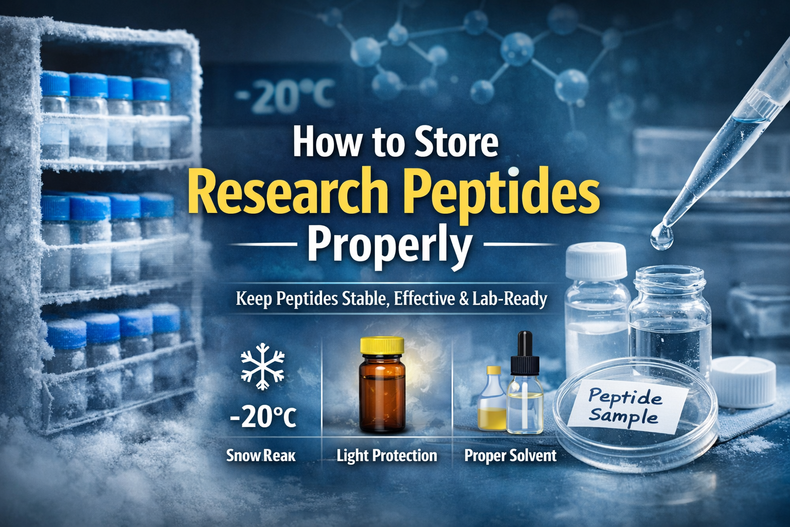
A simple, lab-friendly guide on how to store research peptides so they stay stable, effective, and reliable
If your research results feel inconsistent… your peptides might be the reason.
Peptides are extremely sensitive. Heat, light, moisture, and even air can slowly break them down, often without any visible change. The vial may look fine, but the activity could already be gone.
The good news?
Learning how to store research peptides properly is simple once you understand the basics. In this guide, you’ll get clear, practical steps you can follow in any lab, whether you're a beginner or experienced researcher.
Quick Answer (Save This)
Most research peptides should be:
- Stored as lyophilized (dry powder) at –20°C or lower
- Kept in airtight, light-protected vials
- Protected from moisture and air exposure
- After mixing (reconstitution), stored at 2–8°C (refrigerator)
- Used within 1–4 weeks (depending on peptide)
- Never repeatedly frozen and thawed
That’s the core of how to store research peptides correctly.
Why Proper Storage Matters
Peptides are made of amino acids linked together. These bonds are fragile.
When exposed to the wrong conditions, peptides can break down through:
- Heat → speeds up chemical reactions
- Moisture → causes hydrolysis (bond breakdown)
- Oxygen → leads to oxidation
- Light → damages sensitive amino acids
Important:
A degraded peptide often looks exactly the same. Clear liquid does NOT mean it’s still active.
Bad storage = unreliable results.
How to Store Lyophilized (Dry) Peptides
This is the most stable form of peptides.
Ideal Temperature
| Storage Type | Temperature | How Long |
|---|---|---|
| Freezer | –20°C | Months to years |
| Ultra-cold freezer | –80°C | Long-term storage |
| Refrigerator | 2–8°C | Short-term only |
| Room temp | 18–25°C | Avoid if possible |
Best practice: Store at –20°C minimum.
Protect from Moisture (Very Important)
Cold vials attract condensation.
Do this:
- Let vial reach room temperature BEFORE opening
- Store in airtight containers
- Use desiccant packs (moisture absorbers)
Even tiny moisture can start degradation.
Protect from Light
Some peptides break down under light.
Use:
- Amber (dark) vials
- Foil wrap if needed
- Closed storage boxes
How to Store Reconstituted Peptides (After Mixing)
Once peptides are mixed with liquid, they become much less stable.
Storage Temperature
- Short-term: 2–8°C (refrigerator)
- Long-term: –20°C (only in aliquots)
Choosing the Right Solvent
Different peptides need different solvents:
| Peptide Type | Best Solvent |
|---|---|
| Basic peptides | Dilute acetic acid |
| Acidic peptides | Sterile water |
| Hydrophobic peptides | Small amount of DMSO |
| Cysteine peptides | Slightly acidic solution |
If unsure, start with sterile water.
Never Shake Aggressively
- Don’t shake hard
- Gently swirl or roll the vial
Rough handling can damage peptide structure.
The Freeze-Thaw Problem (Biggest Mistake)
Every time you freeze and thaw a peptide:
It degrades a little more.
Do this repeatedly → peptide becomes useless.
The Solution: Aliquoting
Aliquoting = dividing into small portions.
Step-by-step:
- Reconstitute peptide
- Split into small vials (single-use amounts)
- Label each vial
- Freeze immediately
- Use one vial at a time
Never refreeze a used vial.
Real Example
You prepare 1 mL peptide solution.
Instead of storing in one vial:
Divide into 10 small vials (100 µL each)
Now:
- Use 1 vial per experiment
- Keep 9 untouched and stable
Best Containers for Peptide Storage
Recommended
- Amber glass vials (best for light protection)
- Cryogenic vials (for ultra-low temps)
- Polypropylene tubes (short-term use)
- Rubber-sealed vials (less air exposure)
Avoid
- Clear plastic (light exposure)
- Cheap plastic (peptide sticking issue)
- Large multi-use containers
Advanced Tip
For sensitive peptides:
Flush vial with argon or nitrogen gas
This removes oxygen → reduces oxidation.
Special Peptides That Need Extra Care
Some peptides degrade faster.
Cysteine Peptides
- Easily oxidize
- Use acidic solution
- Avoid oxygen exposure
Methionine Peptides
- Sensitive to light + oxygen
- Store in dark, sealed vials
Glutamine / Asparagine
- Can degrade at high pH
- Keep slightly acidic
Short Peptides
- Break down faster
- Keep dry until use
Labeling & Tracking (Often Ignored)
Every vial should include:
- Peptide name
- Concentration
- Solvent used
- Date of mixing
- Expiry estimate
If you don’t label it properly, don’t trust it.
Common Mistakes (And Fixes)
Opening cold vial immediately
Fix: Let it warm first
Repeated freeze-thaw
Fix: Use aliquots
Leaving at room temperature
Fix: Refrigerate quickly
Wrong solvent
Fix: Match peptide type
Poor labeling
Fix: Label immediately
Simple Daily Checklist
Before ending your workday:
- Peptides stored at correct temperature
- Vials sealed properly
- All samples labeled
- No thawed peptide left unused
- Storage boxes closed and protected
Beginner vs Advanced Storage (Quick View)
| Level | What You Do |
|---|---|
| Beginner | Store at –20°C, avoid light, refrigerate after mixing |
| Intermediate | Aliquot peptides, avoid freeze-thaw |
| Advanced | Use inert gas, choose solvents carefully, control pH |
Key Takeaways
- Store dry peptides at –20°C or colder
- Keep away from light, air, and moisture
- After mixing, store at 2–8°C
- Aliquot to avoid freeze-thaw damage
- Use proper containers and solvents
- Label everything clearly
Final Thoughts
Knowing how to store research peptides properly is not just a small detail — it’s the foundation of good research.
If your storage is wrong:
Your results are wrong.
If your storage is correct:
Your data becomes reliable, repeatable, and trustworthy.
The best part?
You don’t need complicated systems, just consistent habits.
Bottom Line
Good storage protects your peptides.
Stable peptides protect your research.
Research Use Only Disclaimer:
All peptides are intended for laboratory research purposes only. Not for human or animal use. Always follow proper lab safety guidelines.