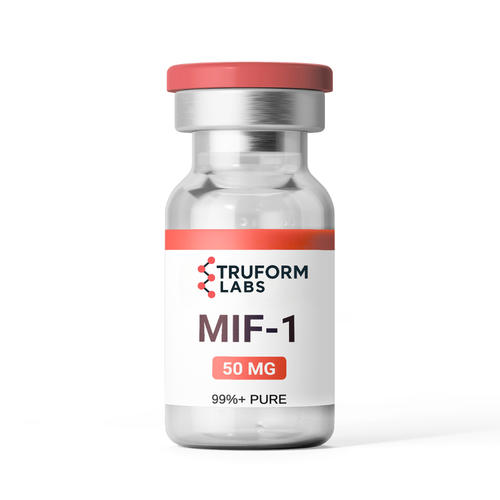
Product Overview
IGF-1 LR3
IGF-1 LR3 (1 mg) is a long-acting analog of insulin-like growth factor-1 (IGF-1), engineered to reduce affinity for IGF-binding proteins and extend half-life, increasing bioavailability and prolonging anabolic activity compared to native IGF-1.[1][2] IGF-1 is a key mediator of skeletal muscle growth, regeneration, and repair through IGF-1R activation of the PI3K/Akt/mTOR pathway, promoting protein synthesis and inhibiting proteolysis.[3][4][5][6][7] It also activates satellite cells to drive myoblast proliferation and differentiation, essential for hypertrophy and recovery after injury.[3][4][8][7]
Preclinical data show IGF-1 LR3 and other variants are more potent than native IGF-1 in enhancing nitrogen retention, body weight, and muscle protein synthesis—especially in catabolic states.[1][2] LR3IGF-1 is reported to be ~1.5–2.5× more potent than IGF-1 in animal models, with superior effects on body weight, nitrogen balance, and reduced muscle protein breakdown, largely due to diminished binding to IGFBPs and improved tissue uptake.[1][2][9]
IGF-1 LR3 improves nutrient partitioning by directing amino acids and glucose toward muscle, supporting lean mass accrual and potentially reducing fat mass.[9][10][11] In animals, IGF-1 analogs increase lean mass and reduce adiposity (with limited preservation of muscle during caloric restriction).[10] In humans, recombinant IGF-1 increases lean body mass, decreases fat mass, and improves protein synthesis/fat oxidation in deficiency states;[11] however, randomized trials in healthy athletes have not shown clear body-composition gains, though some report improved aerobic performance (VO2max).[12][13][14]
IGF-1 LR3 supports tissue repair and accelerates recovery via satellite cell activation, myogenic differentiation, and muscle regeneration—of interest for recovery from intense exertion or musculoskeletal injury.[3][4][15][16][7]
While potent in preclinical models, IGF-1 LR3 is not approved for performance enhancement in humans, and safety at supraphysiologic doses is not fully defined. Potential risks include hypoglycemia, edema, and arthralgia, with theoretical tumorigenesis concerns under chronic exposure. IGF-1 and analogs are banned in competitive sports.[9][13][14]
Summary: IGF-1 LR3 is a long-acting IGF-1 analog with anabolic, regenerative, and nutrient-partitioning effects in preclinical studies. Human data support improvements in protein metabolism and body composition primarily in deficiency states; robust evidence for enhancement in healthy individuals is limited.[12][11][13][14]
References
- Tomas FM, Knowles SE, Owens PC, et al. Biochem J. 1992;282(Pt1):91-7. doi:10.1042/bj2820091.
- Tomas FM, Lemmey AB, Read LC, Ballard FJ. J Endocrinol. 1996;150(1):77-84. doi:10.1677/joe.0.1500077.
- Vassilakos G, Barton ER. Compr Physiol. 2018;9(1):413-438. doi:10.1002/cphy.c180010.
- Ahmad SS, Ahmad K, Lee EJ, et al. Cells. 2020;9(8):E1773. doi:10.3390/cells9081773.
- Philippou A, Barton ER. Growth Horm IGF Res. 2014;24(5):157-63. doi:10.1016/j.ghir.2014.06.003.
- Velloso CP. Br J Pharmacol. 2008;154(3):557-68. doi:10.1038/bjp.2008.153.
- Yoshida T, Delafontaine P. Cells. 2020;9(9):E1970. doi:10.3390/cells9091970.
- Duan C, Ren H, Gao S. Gen Comp Endocrinol. 2010;167(3):344-51. doi:10.1016/j.ygcen.2010.04.009.
- Bailes J, Soloviev M. Biomolecules. 2021;11(2):217. doi:10.3390/biom11020217.
- Tomas FM. Growth Horm IGF Res. 2001;11(2):92-103. doi:10.1054/ghir.2000.0194.
- Mauras N, Martinez V, Rini A, Guevara-Aguirre J. J Clin Endocrinol Metab. 2000;85(9):3036-42. doi:10.1210/jcem.85.9.6772.
- Guha N, Nevitt SP, Francis M, et al. J Clin Endocrinol Metab. 2015;100(8):3126-31. doi:10.1210/jc.2015-1996.
- Anderson LJ, Tamayose JM, Garcia JM. Mol Cell Endocrinol. 2018;464:65-74. doi:10.1016/j.mce.2017.06.010.
- Holt RI, Sönksen PH. Br J Pharmacol. 2008;154(3):542-56. doi:10.1038/bjp.2008.99.
- Song YH, Song JL, Delafontaine P, Godard MP. Trends Endocrinol Metab. 2013;24(6):310-9. doi:10.1016/j.tem.2013.03.004.
- Barton ER. Appl Physiol Nutr Metab. 2006;31(6):791-7. doi:10.1139/h06-054.
All COA’s avail upon request by email info@truformlabs.com.
Storage & Handling (Research Use)
- Lyophilized (dry) peptide: Store sealed at −20 °C (long-term). Short-term storage up to 2–3 weeks at 2–8 °C is acceptable.
- After reconstitution: Store at 2–8 °C and use within 7 days, or aliquot into sterile vials and freeze at −20 °C for up to 3 months.
- Light & moisture: Protect from light; keep container tightly closed to avoid moisture uptake.
- Freeze–thaw: Avoid repeated freeze–thaw cycles (use aliquots).
- Solvent compatibility: Choose sterile solvent compatible with your protocol; filter-sterilize if required by your procedures.
- Labeling: Clearly label aliquots with concentration, solvent, and date of preparation.
Storage guidance is general for research peptides and may be adjusted per your lab SOP.