
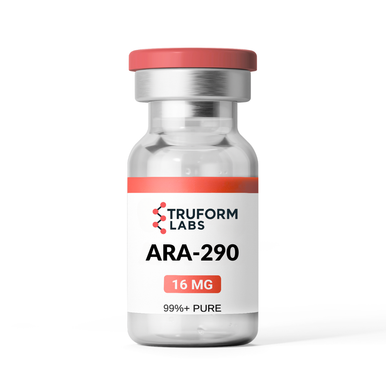
ARA- 290 – 16MG
Log in to view pricing
Apply for provider account
ARA-290 Clinical Summary
ARA-290: Mechanism, Indications, and Evidence
Mechanism of Action
ARA-290 (also known as Cibinetide, pHBSP) is a synthetic nonerythropoietic peptide derived from erythropoietin’s helix B surface. It selectively activates the innate repair receptor (IRR, CD131/EPOR heterodimer), mediating tissue protection and anti-inflammatory effects without stimulating erythropoiesis.[1][2][3][4] ARA-290 inhibits NF-κB phosphorylation, reduces reactive oxygen species (ROS) production, and suppresses NLRP3 inflammasome activation in Schwann cells after peripheral nerve injury.[5] It also modulates immune cell populations, increasing regulatory T cells and Th2 polarization while suppressing Th1/Th17 responses.[3][4]
Clinical Indications and Evidence
Neuropathic Pain:
- Long-term relief of tactile and cold allodynia in rodent models of peripheral nerve injury, dependent on β-common receptor activation.[2][6]
- In humans with type 2 diabetes and painful neuropathy, daily subcutaneous ARA-290 (4 mg for 28 days) improved neuropathic symptoms (PainDetect), increased corneal nerve fiber density, and showed a favorable safety profile.[1]
- Dose-dependent suppression of spinal microglia reactivity correlates with sustained analgesic effects.[6]
- Direct antagonism of TRPV1 channels may contribute to analgesic properties.[7]
Metabolic Control in Diabetes:
- Phase 2 data: improved HbA1c and lipid profiles alongside neuropathic symptom improvement and corneal nerve fiber density in type 2 diabetes.[1]
Neuroinflammatory and Autoimmune Disorders:
- In experimental autoimmune neuritis and encephalomyelitis, ARA-290 reduced disease severity, promoted nerve regeneration/remyelination, and suppressed inflammatory cytokines (IL-1β, IL-17, TNF-α, IFN-γ, iNOS, MMP9, T-bet).[3][4]
- Modulates T cell differentiation and macrophage activation, favoring anti-inflammatory phenotypes.[3][4]
Alzheimer’s Disease (Preclinical):
- Early systemic administration in APP/PS1 mice decelerated amyloid-β pathology and improved cognition, associated with increased Ly6C patrolling monocytes and enhanced Aβ clearance.[8]
Safety
ARA-290 is reported to be devoid of erythropoietic and cardiovascular side effects associated with erythropoietin.[1][2][3][4][9][6] Clinical trials at studied doses have not identified significant safety issues.[1]
Summary
ARA-290 is a promising nonerythropoietic peptide with preclinical and early clinical evidence for neuropathic pain, metabolic control in diabetes, and neuroinflammatory conditions. Its actions include anti-inflammatory, neuroprotective, and immunomodulatory effects. While 4 mg daily has human data support, higher doses such as 16 mg lack published safety/efficacy data.[1]
References
- Brines M, Dunne AN, van Velzen M, et al. Molecular Medicine. 2015;20:658-66. doi:10.2119/molmed.2014.00215.
- Swartjes M, Morariu A, Niesters M, et al. Anesthesiology. 2011;115(5):1084-92. doi:10.1097/ALN.0b013e31822fcefd.
- Liu Y, Luo B, Han F, et al. PLoS One. 2014;9(3):e90942. doi:10.1371/journal.pone.0090942.
- Chen H, Luo B, Yang X, et al. J Neuroimmunol. 2014;268(1-2):64-70. doi:10.1016/j.jneuroim.2014.01.006.
- Liu G, Li W, Jiang S, et al. Eur J Pharmacol. 2025;997:177610. doi:10.1016/j.ejphar.2025.177610.
- Swartjes M, van Velzen M, Niesters M, et al. Molecular Pain. 2014;10:13. doi:10.1186/1744-8069-10-13.
- Zhang W, Yu G, Zhang M. Peptides. 2016;76:73-9. doi:10.1016/j.peptides.2016.01.003.
- Al-Onaizi MA, Thériault P, Lecordier S, et al. Brain Behav Immun. 2022;99:363-382. doi:10.1016/j.bbi.2021.07.016.
- Pulman KG, Smith M, Mengozzi M, Ghezzi P, Dilley A. Neuroscience. 2013;233:174-83. doi:10.1016/j.neuroscience.2012.12.022.
All COA’s avail upon request by email info@truformlabs.com.
Storage & Handling (Research Use)
- Lyophilized (dry) peptide: Store sealed at −20 °C (long-term). Short-term storage up to 2–3 weeks at 2–8 °C is acceptable.
- After reconstitution: Store at 2–8 °C and use within 7 days, or aliquot into sterile vials and freeze at −20 °C for up to 3 months.
- Light & moisture: Protect from light; keep container tightly closed to avoid moisture uptake.
- Freeze–thaw: Avoid repeated freeze–thaw cycles (use aliquots).
- Solvent compatibility: Choose sterile solvent compatible with your protocol; filter-sterilize if required by your procedures.
- Labeling: Clearly label aliquots with concentration, solvent, and date of preparation.
Storage guidance is general for research peptides and may be adjusted per your lab SOP.