
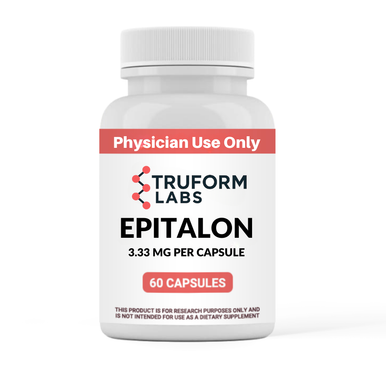
Epitalon Capsules – 3.3MG (60 Capsules)
Log in to view pricing
Apply for provider account
814 in stock
Epithalon Anti-Aging Profile
Epithalon (Ala–Glu–Asp–Gly) is a synthetic tetrapeptide derived from the pineal gland, extensively studied for its geroprotective and anti-aging effects. Mechanistically, Epithalon upregulates telomerase activity and extends telomere length in normal human cells, a process linked to cellular longevity and reduced risk of aging-related diseases.[1][2][3] In vitro, Epithalon increases hTERT mRNA expression and telomerase enzyme activity, resulting in dose-dependent telomere extension in normal cells.[1] In animal models, Epithalon administration increases maximum lifespan and delays age-related functional decline.[4][5][6]
Epithalon exerts a direct influence on circadian rhythms by restoring melatonin and cortisol secretion patterns in aged primates, which is associated with improved sleep quality and neuroendocrine regulation.[7][8] These effects are mediated through modulation of pineal gland function and transcriptional regulation of genes involved in melatonin synthesis.[8]
Immunomodulatory properties include enhancement of thymocyte mitogenic activity, upregulation of interleukin-2 mRNA, and normalization of immune parameters in aged animals.[7][8] These actions contribute to improved immune surveillance and reduced incidence of age-related malignancies, as demonstrated by inhibition of spontaneous leukemia development in murine models.[4]
Epithalon demonstrates potent antioxidant effects, at times exceeding those of melatonin, by increasing superoxide dismutase (SOD) activity and upregulating other antioxidant enzymes.[9][10][6] This corresponds with reduced lipid/protein peroxidation, lower reactive oxygen species (ROS), and enhanced resistance to oxidative stress in animal and human studies.[11][9][10][6]
Epithalon also promotes DNA repair and genomic stability, evidenced by decreased chromosome aberrations in bone marrow cells and improved mitochondrial function in oocytes.[11][4][3] In stem cell models, it stimulates gene expression and protein synthesis involved in neurogenesis and differentiation, suggesting an epigenetic mechanism for its tissue-protective effects.[12]
Collectively, Epithalon’s actions on telomerase activation, circadian rhythm restoration, immune enhancement, oxidative-stress resistance, and DNA repair position it as a promising agent for promoting healthy aging and longevity.[1][7][11][8][9][12][4][5][2][3][10][6] Typical research doses in animal studies range from microgram to milligram quantities, with 10 mg referenced in experimental protocols; however, optimal human dosing and long-term safety require further clinical investigation.[7][4]
References
- Al-Dulaimi S, Thomas R, Matta S, Roberts T. Biogerontology. 2025;26(5):178. doi:10.1007/s10522-025-10315-x.
- Fossel M. JAMA. 1998;279(21):1732-5. doi:10.1001/jama.279.21.1732.
- Ullah S, Haider Z, Perera CD, et al. Life Sci. 2025;362:123381. doi:10.1016/j.lfs.2025.123381.
- Anisimov VN, Khavinson VKh, Popovich IG, et al. Biogerontology. 2003;4(4):193-202. doi:10.1023/a:1025114230714.
- Khavinson VK, Izmaylov DM, Obukhova LK, Malinin VV. Mech Ageing Dev. 2000;120(1-3):141-9. doi:10.1016/s0047-6374(00)00217-7.
- Anisimov VN, Mylnikov SV, Oparina TI, Khavinson VK. Mech Ageing Dev. 1997;97(2):81-91. doi:10.1016/s0047-6374(97)01897-6.
- Araj SK, Brzezik J, Mądra-Gackowska K, Szeleszczuk Ł. Int J Mol Sci. 2025;26(6):2691. doi:10.3390/ijms26062691.
- Khavinson VKh. Neuro Endocrinol Lett. 2002;23 Suppl 3:11-144.
- Kozina LS, Arutjunyan AV, Khavinson VKh. Arch Gerontol Geriatr. 2007;44 Suppl 1:213-6. doi:10.1016/j.archger.2007.01.029.
- Anisimov VN, Arutjunyan AV, Khavinson VK. Neuro Endocrinol Lett. 2001;22(1):9-18.
- Yue X, Liu SL, Guo JN, et al. Aging (Albany NY). 2022;14(7):3191-3202. doi:10.18632/aging.204007.
- Khavinson V, Diomede F, Mironova E, et al. Molecules. 2020;25(3):E609. doi:10.3390/molecules25030609.
All COA’s avail upon request by email info@truformlabs.com.
Storage & Handling (Research Use)
- Lyophilized (dry) peptide: Store sealed at −20 °C (long-term). Short-term storage up to 2–3 weeks at 2–8 °C is acceptable.
- After reconstitution: Store at 2–8 °C and use within 7 days, or aliquot into sterile vials and freeze at −20 °C for up to 3 months.
- Light & moisture: Protect from light; keep container tightly closed to avoid moisture uptake.
- Freeze–thaw: Avoid repeated freeze–thaw cycles (use aliquots).
- Solvent compatibility: Choose sterile solvent compatible with your protocol; filter-sterilize if required by your procedures.
- Labeling: Clearly label aliquots with concentration, solvent, and date of preparation.