
All information provided is for research purposes only.
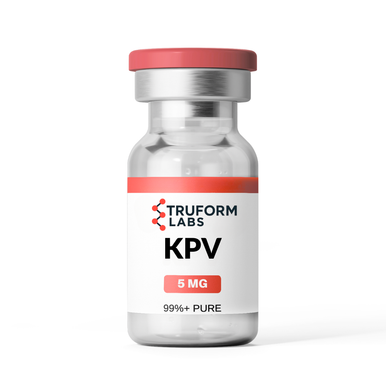
KPV – 5MG
Log in to view pricing
Apply for provider account
KPV Peptide
KPV (Lys–Pro–Val) is a tripeptide derived from the C-terminus of α-MSH with potent anti-inflammatory and mucosal-healing actions. KPV primarily inhibits NF-κB and MAPK signaling, lowering pro-inflammatory cytokine secretion in epithelial and immune cells. It is actively transported via PepT1, which is upregulated in the inflamed colon—focusing activity to diseased tissue.[1]
Mechanism & Cellular Uptake
- Suppresses NF-κB/MAPK pathways → ↓ TNF-α, IL-1β, other cytokines in gut epithelium and immune cells.[1,2,4,5]
- PepT1-mediated entry enhances epithelial uptake during IBD flares (PepT1 upregulated).[1]
- Anti-inflammatory activity partly melanocortin-receptor independent → minimal pigmentary effects versus α-MSH.[2,4,5]
Efficacy in Colitis & Mucosal Healing
- DSS/TNBS colitis (mice): oral/rectal KPV ↓ histologic inflammation, cytokines, and MPO; improves weight recovery and mucosal repair.[1–3]
- Oral mucositis: mucoadhesive KPV hydrogels reduce inflammation/bacterial burden and promote epithelial repair.[6]
Broader Anti-Inflammatory Applications
- Peritonitis and other sterile inflammation models: ↓ neutrophil infiltration and pro-inflammatory mediators.[4]
- Vascular disease: carrier-free KPV nanodrugs show anti-inflammation and anti-calcification effects in preclinical models.[8]
Formulation & Delivery
- Hydrogel encapsulation improves peptide stability, mucosal retention, and in vivo efficacy in colitis.[3,6]
- Transdermal strategies (iontophoresis/microneedles, microporated skin) enable enhanced delivery across human skin.[7]
Safety
- KPV and derivatives (e.g., (CKPV)2) show a favorable preclinical safety profile with no significant cytotoxicity or pigmentary effects reported.[2,4,5,9]
Key Takeaways
- Targeted gut delivery: PepT1-guided epithelial uptake concentrates action in inflamed colon.
- Multi-pathway anti-inflammation: NF-κB/MAPK inhibition plus cytokine reduction and epithelial repair.
- Translational flexibility: oral/rectal hydrogels and transdermal systems broaden therapeutic options.
References
- Dalmasso G, Charrier-Hisamuddin L, Nguyen HT, et al. Gastroenterology. 2008;134(1):166-178. doi:10.1053/j.gastro.2007.10.026.[1]
- Kannengiesser K, Maaser C, Heidemann J, et al. Inflamm Bowel Dis. 2008;14(3):324-331. doi:10.1002/ibd.20334.[2]
- Sun J, Xue P, Liu J, et al. ACS Biomater Sci Eng. 2021;7(10):4859-4869. doi:10.1021/acsbiomaterials.1c00792.[3]
- Getting SJ, Schiöth HB, Perretti M. J Pharmacol Exp Ther. 2003;306(2):631-637. doi:10.1124/jpet.103.051623.[4]
- Brzoska T, Böhm M, Lügering A, et al. Adv Exp Med Biol. 2010;681:107-116. doi:10.1007/978-1-4419-6354-3_8.[5]
- Shao W, Chen R, Lin G, et al. Biomater Sci. 2021;10(1):227-242. doi:10.1039/d1bm01466h.[6]
- Pawar K, Kolli CS, Rangari VK, Babu RJ. J Pharm Sci. 2017;106(7):1814-1820. doi:10.1016/j.xphs.2017.03.017.[7]
- Zhang L, Li D, Aierken Y, et al. Adv Healthc Mater. 2024;13(32):e2402320. doi:10.1002/adhm.202402320.[8]
- Gatti S, Carlin A, Sordi A, et al. J Surg Res. 2006;131(2):209-214. doi:10.1016/j.jss.2005.08.009.[9]
All information provided is for research purposes only.