
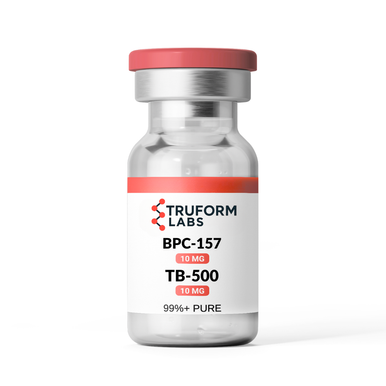
Wolverine Blend (BPC-157/10MG – TB-500/10MG)
Log in to view pricing
Apply for provider account
Wolverine Blend • Synergistic BPC-157 (10 mg) + TB500 (10 mg)
A synergistic blend of BPC-157 and TB500 designed to leverage complementary regenerative and anti-inflammatory properties for advanced tissue repair and optimal recovery.
BPC-157
Stable gastric pentadecapeptide with broad evidence for accelerating healing in skin, muscle, tendon, ligament, bone, nerve, and GI tissues. Promotes angiogenesis, enhances fibroblast/endothelial migration, and upregulates growth hormone receptor in tendon fibroblasts. Modulates the nitric oxide (NO) system to improve vasodilation, blood flow, and tissue oxygenation, with anti-inflammatory actions via suppression of pro-inflammatory cytokines and oxidative stress and restoration of tissue homeostasis.[1–11]
TB500 (thymosin β4)
Multifunctional peptide supporting repair by promoting cell migration, angiogenesis, and stem-cell maturation. Downregulates inflammatory chemokines/cytokines, enhances neovascularization, and accelerates wound healing across dermal, corneal, cardiac, and musculoskeletal tissues. Actin-sequestering properties facilitate cytoskeletal remodeling essential for regeneration after injury.[12–13]
Synergistic Mechanisms & Clinical Implications
- Advanced Tissue Repair: Dual targeting of inflammation resolution, cell migration, angiogenesis, and matrix remodeling. BPC-157’s GHR upregulation in tendon fibroblasts may potentiate TB500’s regenerative effect.[9,12–13]
- Reduced Inflammation: Both peptides suppress pro-inflammatory cytokines/chemokines, reduce oxidative stress, and promote balanced immune responses to speed resolution and minimize fibrosis.[6–7,12–13]
- Optimal Recovery: Preclinical models show accelerated recovery from musculoskeletal injury, improved function, and shortened downtime with minimal reported adverse effects.[1–5,12–13]
Safety
Both peptides demonstrate favorable safety profiles in preclinical and early clinical literature; BPC-157 reports no toxicity at therapeutic ranges, and TB500 is well tolerated in ongoing clinical work.[1–5,12–14]
References
- Seiwerth S, Milavic M, Vukojevic J, et al. Front Pharmacol. 2021;12:627533.
- Gwyer D, Wragg NM, Wilson SL. Cell Tissue Res. 2019;377(2):153-159.
- Seiwerth S, Rucman R, Turkovic B, et al. Curr Pharm Des. 2018;24(18):1972-1989.
- Sikiric P, Seiwerth S, Brcic L, et al. Curr Pharm Des. 2010;16(10):1224-1234.
- Sikiric P, Drmic D, Sever M, et al. Curr Pharm Des. 2020;26(25):2991-3000.
- Sikiric P, Seiwerth S, Rucman R, et al. Curr Pharm Des. 2017;23(27):4012-4028.
- Sikiric P, Seiwerth S, Skrtic A, et al. Pharmaceuticals. 2025;18(6):928.
- Lojo N, Rasic Z, Zenko Sever A, et al. PLOS ONE. 2016;11(9):e0162590.
- Chang CH, Tsai WC, Hsu YH, Pang JH. Molecules. 2014;19(11):19066-77.
- Sikiric P, Seiwerth S, Rucman R, et al. Curr Neuropharmacol. 2016;14(8):857-865.
- Hsieh MJ, Lee CH, Chueh HY, et al. Sci Rep. 2020;10:17078.
- Philp D, Kleinman HK. Ann N Y Acad Sci. 2010;1194:81-86.
- Goldstein AL, Kleinman HK. Expert Opin Biol Ther. 2015;15(S1):S139-145.
- Józwiak M, Bauer M, Kamysz W, Kleczkowska P. Pharmaceuticals. 2025;18(2):185.
All COA’s avail upon request by email info@truformlabs.com.
Storage & Handling (Research Use)
- Lyophilized (dry) vials: Store sealed at −20 °C (long-term), desiccated and protected from light. Short-term (≤2–3 weeks) at 2–8 °C is acceptable.
- After reconstitution: Store at 2–8 °C and use within 7 days, or aliquot and freeze at −20 °C for up to 3 months.
- Avoid freeze–thaw: Prepare small aliquots to prevent repeated cycles.
- Solvent: Reconstitute per protocol (e.g., sterile saline/bacteriostatic water). For blends, avoid strong chelators that could impact peptide complexes.
- Handling: Keep solutions on ice during use; discard any unused thawed aliquots.
- Labeling: Mark concentration, solvent, and prep date on all aliquots.