
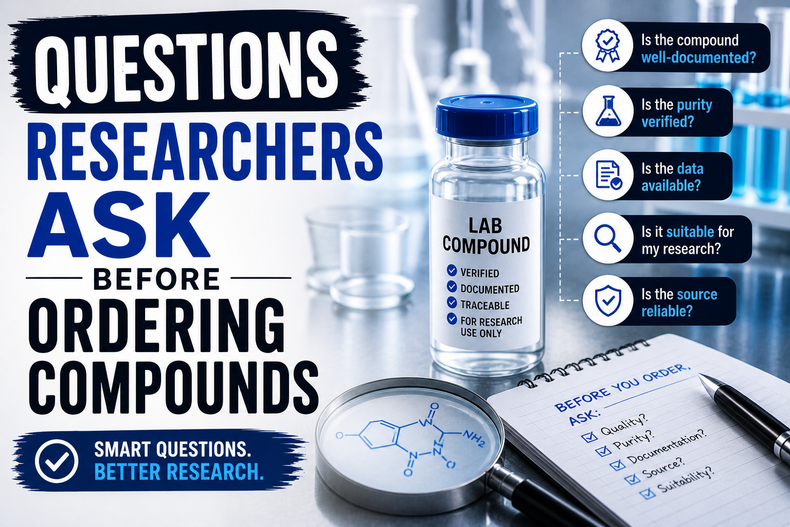
A clear, helpful guide to the smart questions scientists ask before choosing the right materials for their work.
Imagine you are building something important, a birdhouse, a cake, or a science project. Before you start, you need to make sure you have the right materials. Scientists feel the same way. Before they order any compound for their research, they ask a series of careful, thoughtful questions.
In research labs around the world, scientists work with compounds, substances made from two or more elements joined together. These could be anything from a simple salt to a complex molecule used to study a disease. Choosing the right compound is a big deal. The wrong choice can waste time, money, and effort. The right choice can lead to a breakthrough.
Here are the most important questions researchers ask before placing that order, explained in a way that anyone can understand.
Q1. What exactly do I need this compound to do?
This is always the first question. Before anything else, a researcher has to be crystal clear about the purpose of the compound. Is it going to be used in an experiment to test a hypothesis? Will it be a reference material to compare other results against? Is it a building block for creating something new?
Think of it like asking, "Why am I buying this ingredient?" before going to the grocery store. A bag of sugar behaves very differently in a cake than it does in lemonade. Similarly, the same compound might behave very differently depending on what a scientist needs it to do.
Q2. How pure does it need to be?
Purity is one of the most critical factors in research. A compound's purity level tells you how much of the substance is actually the compound you want, versus other things mixed in. In scientific terms, this is usually expressed as a percentage, like 95%, 99%, or 99.9% pure.
For some experiments, a purity of 95% is perfectly fine. For others, especially in medicine, biology, or highly sensitive testing, researchers may need purity levels of 99.9% or higher. Even tiny amounts of unwanted material can completely change the outcome of an experiment.
Q3. Is this compound stable and how should it be stored?
Some compounds are very stable, meaning they hold their chemical structure over a long period of time. Others are sensitive, they can break down when exposed to light, heat, air, or moisture. Researchers need to know this before they order, not after they receive a degraded sample.
Questions about stability include: Does this compound need to be refrigerated? Stored in a dark container? Protected from humidity? Does it have a short shelf life? Ordering a compound without knowing how to store it properly is like buying ice cream without a freezer, it works out badly, and quickly.
"In science, knowing how to keep something intact is just as important as knowing what it is."
Q4. What are the safety considerations?
Safety is never an afterthought in a research setting. Before ordering any compound, researchers study what are called Safety Data Sheets (SDS), documents that explain potential hazards, how to handle the compound safely, what protective equipment is needed, and what to do in case of an accident.
Some compounds are mild and safe to handle with basic precautions, like wearing gloves and goggles. Others require specialized ventilation systems, full protective suits, or must only be handled in particular types of facilities. Knowing this upfront protects not just the researcher, but their entire team and the surrounding environment.
Q5. Is this the right supplier, and can they prove quality?
Not all suppliers are created equal. A compound ordered from one company might have different impurity levels, different particle sizes, or different processing methods than the same compound from another company, even if the labels look identical.
Researchers look for suppliers who provide Certificates of Analysis (CoA). These are official documents that describe what tests were run on a batch, what the results were, and how the compound meets quality standards. Without this documentation, a researcher is essentially trusting a label without any proof.
Q6. How much do I actually need?
Ordering the right quantity is more nuanced than it sounds. Ordering too little means running out in the middle of an experiment, which can ruin results if conditions change between batches. Ordering too much wastes money and creates storage challenges, especially for compounds with limited shelf lives.
Experienced researchers calculate how much compound they need for their planned number of tests, add a buffer for errors or repeat runs, and factor in the compound's stability over time. They also consider whether extra stock from the same batch should be preserved for future reference.
Q7. Are there any legal or regulatory requirements?
Many compounds, especially those used in pharmaceutical research, agriculture, or environmental studies, are regulated by government agencies. Researchers must confirm that their institution is licensed to receive, store, and use such materials. In some cases, detailed paperwork must be filed before an order is even placed.
For international orders, researchers also check export and import restrictions. Certain compounds cannot be shipped across borders without special permits. Ignoring these rules is not just a procedural problem, it can lead to serious legal consequences for the researcher and their institution.
Q8. What is the cost, and is there a better alternative?
Research budgets are real, and they are rarely unlimited. A researcher might want a highly pure, freshly synthesized compound, but the cost might be prohibitive. So they explore questions like: Is there a lower-cost option that still meets the purity requirement? Can the compound be synthesized in-house instead of purchased? Is there a suitable substitute that has already been validated?
Cost-consciousness in research is not about cutting corners, it is about being a good steward of resources, especially in publicly funded or grant-based research environments where every dollar must be justified.
Q9. How quickly do I need it and what are the shipping conditions?
Timing matters in research. Some compounds need to arrive fresh, in controlled temperature conditions, or within a narrow window before an experiment begins. Researchers confirm delivery timelines, ask about packaging, and verify whether the supplier uses appropriate temperature-controlled shipping for sensitive materials.
A compound that is left on a loading dock in summer heat for two days may have already degraded before it ever reaches the lab, even if it was perfect when it left the warehouse.
The big picture
These questions might seem like a lot of work just to place a simple order. But in science, preparation is everything. A well-chosen compound, properly understood and carefully sourced, is the foundation of reliable, reproducible, and meaningful research. Every great discovery started with someone asking exactly the right question at exactly the right time.
Quick checklist before ordering a compound
✓Define the purpose, what role will this compound play in your work?
✓Confirm the required purity level for your specific application
✓Understand stability and storage requirements
✓Review the Safety Data Sheet and prepare appropriate handling measures
✓Verify the supplier's Certificate of Analysis and reputation
✓Calculate the right quantity, not too little, not too much
✓Check legal and regulatory compliance for your location
✓Evaluate cost and consider alternatives if needed
✓Confirm delivery timeline and appropriate shipping conditions
Science at its best is a careful, deliberate process. The researchers who ask these questions are not being slow or overly cautious, they are being thorough. And thoroughness, in the world of research, is what separates reliable results from wasted effort.
Whether you are a student curious about how science works, a newcomer to a research lab, or simply someone who loves learning, understanding this process gives you a window into how scientists think. Before they ever touch a test tube, they ask the right questions. And that habit, more than anything else, is what makes good science possible.