
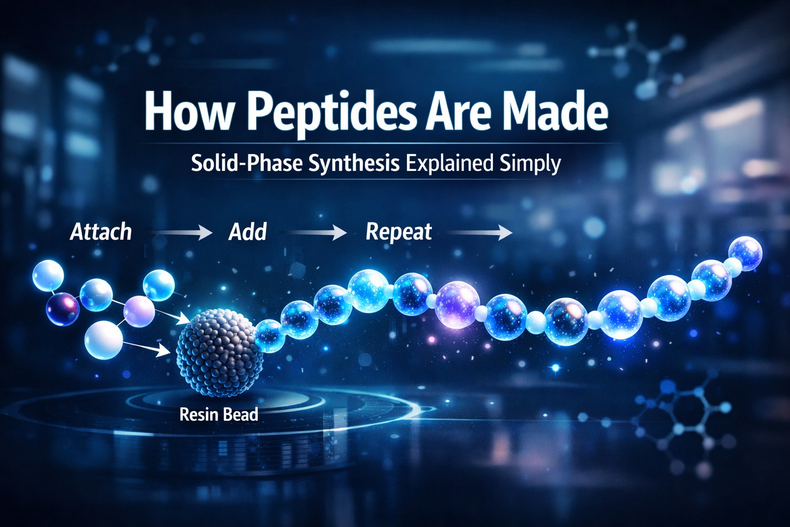
Ever wonder how a peptide goes from a lab idea to a real molecule that actually works in your body? The answer is more fascinating, and more precise... than you'd think.
Think about building with LEGO bricks. You start with one brick, snap on another, then another, until you have a whole structure. Now imagine doing that, but the "bricks" are invisible to the naked eye, and you need to connect them in the exact right order to create something that could one day help heal the human body.
That's basically what solid-phase peptide synthesis, or SPPS, is. It's the method scientists use to build peptides, those short chains of amino acids that act like tiny messengers and workers inside your body. And today, we're going to walk you through exactly how it works, step by step, in plain everyday English.
What Is a Peptide? (Quick Refresher)
Before we dive into how peptides are made, let's get clear on what they actually are.
A peptide is a short chain of amino acids linked together. Amino acids are the basic building blocks of all proteins. Here's the simplest way to think about it:
When you string two to fifty amino acids together, you get a peptide. String many more together and you get a full protein. Peptides are found naturally all over your body, some help carry signals between cells, some fight bacteria, some tell your body to release hormones, and others play roles in skin repair, muscle recovery, and immune response.
Insulin — the hormone used to treat diabetes - is actually a peptide. It's made of just 51 amino acids. The ability to synthesize peptides in a lab has made life-saving medications like insulin far more accessible and affordable for millions of people around the world.
Because peptides do so many important jobs in the body, scientists want to study them, modify them, and even create brand-new ones. That's where peptide synthesis comes in, the process of building a peptide artificially in a lab, with complete control over its structure.
Two Ways to Make a Peptide - And Why One Won
There are two main approaches to synthesizing peptides in a lab:
- Solution-Phase Peptide Synthesis - the older, traditional method where all the chemistry happens while everything floats freely in a liquid solution.
- Solid-Phase Peptide Synthesis (SPPS) - the modern method, where one end of the growing peptide chain is anchored to a solid bead called a resin, and you build the chain while it stays in place.
For a long time, solution-phase synthesis was the only option. But it had real problems, it was slow, messy, and hard to scale up. Every step created a new product that had to be carefully separated and purified before you could move on. That took a lot of time and created a lot of waste.
Then in 1963, a chemist named Robert Bruce Merrifield had a smarter idea. He thought: what if we kept the growing peptide chain attached to a solid support the whole time? That way, you don't lose any of it during washing steps, and the whole process becomes much faster and cleaner. His idea worked so well that he won the Nobel Prize in Chemistry in 1984 for it.
"Merrifield's SPPS idea turned peptide chemistry from a slow, painstaking art into a fast, reliable, repeatable science - and opened the door to modern peptide drug development."

TheraTideUSA.com - Peptide Science Series
Today, solid-phase peptide synthesis is the gold standard for making peptides in research labs, pharmaceutical companies, and biotech firms all over the world.
Solid-Phase Peptide Synthesis (SPPS): The Big Idea
Let's break down how SPPS actually works. Think of it like building a pearl necklace, but instead of stringing pearls in the air, you start with one pearl already attached to a fixed post, and you keep adding new pearls one at a time until your necklace is complete. When you're done, you cut it off the post.
In SPPS, the growing peptide chain is always attached to a solid resin - small polymer beads that act as the anchor. You add amino acids one at a time, wash away leftovers between each step, and only cut the finished peptide free at the very end.
The beauty of this approach? Because the peptide is always anchored to the resin, you can rinse, wash, and add new chemicals freely, without losing any of your peptide in the process.
The SPPS Process: Step by Step
Here's the full process scientists follow when building a peptide using SPPS. It follows a simple, repeating cycle, once for each amino acid being added to the chain.
The process starts by bonding the very first amino acid, specifically the C-terminal (end) amino acid to the solid resin. This anchors your starting point and keeps the growing chain stable throughout the entire synthesis. Think of the resin as a handle that keeps everything stable while you work.
Each amino acid has parts that can react in unwanted ways if left unguarded. So scientists attach protecting groups, chemical caps to block specific parts temporarily. This ensures that only the correct part reacts during each step. The most common method used today is called Fmoc protection, which we'll explain shortly.
Before the next amino acid can be added, the protecting group (chemical cap) on the free end of the resin-bound chain must be removed. Scientists add a chemical, usually piperidine in the Fmoc method - to take off this cap. Now that end is free and ready to bond. The resin is then washed to clear away all leftover chemicals before the next step.
The next amino acid in the sequence is "activated" using special chemical reagents, think of it like turning on the glue. This activated amino acid is then introduced to the resin, where it bonds to the free end of the growing chain. This bond is called a peptide bond. The resin is washed again to remove anything that didn't react properly.
This is where precision matters most - the order must be exact.Steps 3 and 4 are repeated over and over, once for each amino acid in the desired sequence. If you're building a 20-amino-acid peptide, this cycle runs 20 times. Each cycle adds exactly one amino acid in exactly the right spot.
Once the full peptide chain is built, it's time to cut it loose. Scientists add a cleavage reagent, usually trifluoroacetic acid (TFA) - which breaks the bond between the peptide and the resin, setting the peptide free. This step also removes all the remaining protecting groups from the amino acid side chains at the same time.
The raw peptide isn't pure enough to use right away. It goes through HPLC (High-Performance Liquid Chromatography) a technique that separates the target peptide from any byproducts or incomplete chains. The final peptide is then verified using mass spectrometry to confirm it has the exact correct structure and molecular weight before it's used in research.
Let's say a researcher wants to build this short, 3-amino-acid peptide:
Here's what happens in the lab:
- Attach Val (the C-terminal amino acid) to the resin as the starting anchor
- Deprotect Val's free end, then couple Gly - wash
- Deprotect Gly's free end, then couple Ala - wash
- Cleave the finished Ala–Gly–Val peptide from the resin
- Purify by HPLC and verify by mass spectrometry
Simple as that. Three amino acids, three cycles, one clean peptide, ready for research.
Two Types of SPPS: Fmoc vs. Boc Chemistry
Not all SPPS is done the same way. There are two main strategies used in labs today, and they differ mainly in the type of protecting group they use and how it's removed:
| Feature | Fmoc SPPS | Boc SPPS |
|---|---|---|
| Protecting group | 9-Fluorenylmethoxycarbonyl (Fmoc) | tert-Butyloxycarbonyl (Boc) |
| Removed by | A base (piperidine) | An acid (TFA or HF) |
| Conditions | Milder — safer for delicate amino acids | Harsher — requires strong, corrosive acids |
| Most common today | Yes — the default in modern research labs | Specialized and industrial settings only |
| Ease of use | Easier to handle and automate | Requires more safety precautions |
Fmoc chemistry is by far the most widely used method today. It works under milder conditions, is compatible with a wider range of amino acids, and is much easier to automate. When most people refer to SPPS, they're almost always talking about the Fmoc approach.
How Modern Machines Have Made SPPS Faster Than Ever
Back in Merrifield's day, SPPS was done completely by hand, carefully measured chemicals, manual washes, meticulous timing. It was slow and labor-intensive, taking days or even weeks to complete a single peptide.
Today, much of this work is done by automated peptide synthesizers machines that run the full deprotection-coupling-washing cycle automatically, 24 hours a day, without a scientist needing to stand over them. Some advanced systems can make multiple different peptides simultaneously.
This automation has had a massive impact on science:
- Speed: What once took weeks can now be completed in hours or a single day.
- Consistency: Machines eliminate human error that manual synthesis risks at every step.
- Scale: It's now possible to produce peptides in quantities large enough for clinical trials and pharmaceutical manufacturing.
- Accessibility: More labs worldwide can do peptide research, which means faster scientific discovery overall.
Did You Know?

An automated peptide synthesizer can build a 20-amino-acid peptide in just a few hours.
Without automation, the same peptide could take a skilled scientist several days of careful manual work.
This speed is a complete game-changer for drug development timelines.
Common Challenges in Peptide Synthesis (And How Labs Fix Them)
Even though SPPS is powerful and well-established, it's not without problems. Here are the most common challenges researchers face, and what they do about them:
Sometimes an amino acid doesn't attach properly during the coupling step, leaving some chains shorter than they should be. These are called "deletion sequences" and they show up as impurities in the final product. If even a small percentage of chains miss an amino acid, it affects overall purity, which is why this is the most common issue in SPPS.
Unwanted chemical reactions can occur between amino acids or with the protecting groups, altering the structure of the final peptide in subtle ways. These side reactions can be hard to detect without thorough testing, which is why choosing the right protecting groups and reaction conditions upfront is so important.
Certain amino acid sequences are notoriously tricky to synthesize. Some sequences tend to fold in on themselves during synthesis, like a chain that gets tangled, making it physically hard to add the next amino acid. This is especially common with longer peptides or sequences with lots of hydrophobic (water-avoiding) amino acids.
Even with automation, a mistake in the amino acid sequence, wrong order, wrong amino acid, can completely ruin the peptide. A peptide with a sequence error won't fold or function correctly, making it useless for research.
What Makes a High-Quality Synthesized Peptide?
Beyond avoiding challenges, several factors determine whether a synthesized peptide is genuinely ready for research use:
Purity Level
Even with perfect synthesis, the raw product needs thorough purification via HPLC. The purity level required depends on how the peptide will be used. Research-grade peptides typically need 95%+ purity. Peptides being tested in preclinical or clinical settings may require 98%+, even a tiny amount of the wrong peptide can skew results or cause problems.
Resin Selection
Choosing the right resin is like choosing the right foundation for a building, it affects everything that comes after. Different resins suit different peptide types. Some are better for short peptides, others for long ones. Some work better for water-soluble peptides, others for hydrophobic sequences. Experienced peptide chemists choose resin type as one of their very first decisions.
Mass Verification
After purification, every synthesized peptide should be verified by mass spectrometry to confirm it has the exact correct molecular weight and structure. This step is non-negotiable in professional research settings, it's the final confirmation that what you made is actually what you intended to make.
Why This Science Matters: Real-World Uses of Synthesized Peptides
Solid-phase peptide synthesis isn't just an interesting chemistry method, it's the backbone of an entire industry that is actively changing medicine, science, and healthcare.
- Drug development: Many modern peptide-based drugs, from insulin analogs to GLP-1 receptor agonists like semaglutide (used in weight loss and diabetes treatments) to antiviral and antimicrobial therapies, are produced using SPPS. Without it, these treatments simply wouldn't exist at scale.
- Research tools: Scientists use synthetic peptides to study how proteins function, how viruses infect cells, and how the immune system identifies threats, all of which are critical for developing new vaccines and therapies.
- Diagnostic testing: Synthetic peptides are used in laboratory tests and diagnostic kits to detect specific diseases, measure proteins in blood or tissue samples, and monitor treatment responses.
- Skin care and cosmetics: Some cosmetic peptides, those marketed in anti-aging creams and serums for collagen support and skin repair, are produced using SPPS and incorporated into topical formulas.
- Agricultural science: Antimicrobial peptides synthesized in the lab are being studied as natural, targeted alternatives to traditional antibiotics in livestock and crop protection.
- Cell signaling research: Peptides that mimic natural signaling molecules allow researchers to study and even control specific biological pathways in the lab, opening up new avenues in cancer biology, neuroscience, and metabolic research.
The ability to precisely build peptides from scratch has opened up enormous possibilities, not just in medicine, but across biology, agriculture, diagnostics, and materials science.
The Limitations Scientists Are Still Working to Overcome
SPPS has come a long way, but it's not a perfect solution for every situation. Here's what researchers are still working to improve:
Long Peptides Are Harder to Build
The longer the peptide, the more synthesis cycles are needed and the more chances for small errors to build up. Making peptides longer than 50 amino acids using SPPS alone is technically challenging. That's why very large proteins are usually made using biological expression systems, like engineered bacteria or yeast cells - rather than purely chemical synthesis.
Cost Can Be High
High-quality reagents, specialized resins, and sophisticated equipment make SPPS relatively expensive, especially at scale. This is a significant reason why many peptide-based drugs carry high price tags. Research into greener chemistry and more efficient synthesis processes is actively working to bring these costs down.
Environmental Impact
Traditional SPPS uses significant amounts of organic solvents, some of which are hazardous to the environment. The scientific community is actively developing more sustainable approaches including greener solvents, solvent recycling systems, and process optimization to reduce the environmental footprint of peptide manufacturing.
Quick Recap: Everything You Need to Know
- Peptides are short chains of amino acids - think of them as "words" built from amino acid "letters."
- Solid-Phase Peptide Synthesis (SPPS) is the gold-standard method for building peptides in a lab.
- The SPPS cycle is: Deprotect → Couple → Wash → Repeat — once for each amino acid.
- The growing peptide is always anchored to a solid resin bead throughout the entire process.
- Fmoc chemistry is the modern, most widely used SPPS approach - it's milder and easier to automate.
- Automated synthesizers can build a 20-amino-acid peptide in just a few hours today.
- Common challenges include incomplete coupling, side reactions, and difficult sequences - all have practical fixes.
- Purification by HPLC and verification by mass spectrometry are essential final steps.
- Synthesized peptides are used in drug development, diagnostics, research, skincare, and agriculture.
Final Thoughts
Solid-phase peptide synthesis is one of those scientific breakthroughs that quietly changed the world. Most people have never heard of it, but if you've ever taken a peptide-based medication, benefited from a diagnostic test, or read about a new drug in development, there's a very good chance SPPS made it possible.
From a single Nobel Prize-winning idea in 1963 to automated machines producing life-saving molecules in hours today, SPPS is a perfect example of how one clever solution to a chemistry problem can ripple outward to touch millions of lives.
At TheraTideUSA, we believe that understanding the science behind peptides helps everyone make more informed decisions, whether you're a researcher, a healthcare professional, or simply someone who wants to know more about how modern medicine actually works. Because knowledge, like peptides themselves, can be incredibly powerful when it's put together in exactly the right order.