
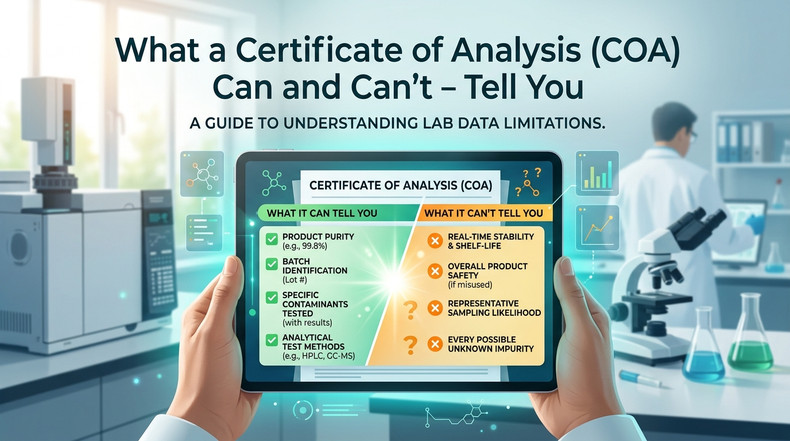
A COA is one of the most important documents in product quality assurance. But knowing how to read one - and understanding its real limits - makes all the difference.
Walk into almost any industry that handles consumable or regulated products food, dietary supplements, pharmaceuticals, industrial chemicals, raw materials, and you'll eventually encounter a Certificate of Analysis. Ask a supplier for proof of quality, and a COA is usually what lands in your inbox.
But there's a common mistake people make: treating a COA as a complete seal of approval. It isn't. A COA is a snapshot, a valuable one, but like any single document, it tells part of the story, not the whole story.
This guide breaks down exactly what a COA covers, where it falls short, and how to use it as one piece of a larger quality picture.
What Is a Certificate of Analysis?
A Certificate of Analysis is a document issued by a laboratory, either a manufacturer's in-house lab or a third-party testing facility, that reports the results of tests performed on a specific batch or lot of a product. It's a formal record confirming whether that batch meets the specifications set for it.
COAs are standard practice across dozens of industries. You'll find them accompanying pharmaceutical ingredients, nutritional supplements, food-grade raw materials, agricultural products, industrial chemicals, cosmetic ingredients, and more. Wherever precise composition matters, a COA is typically required before a product moves to the next stage of the supply chain.
Key Term
A Certificate of Analysis reports lab-tested results for a specific product batch, including purity, potency, identity, and contaminant levels, compared against predetermined specifications.
What a COA Can Tell You
When a COA is issued by a credible, accredited laboratory, it can be an extremely useful document. Here's what it genuinely communicates:
1. Identity Confirmation
A COA typically confirms that what's in the container is actually what the label says it is. Through analytical methods like HPLC (High-Performance Liquid Chromatography), mass spectrometry, or infrared spectroscopy, labs can verify the chemical identity of an ingredient or compound. This matters enormously in industries like herbal supplements, where mislabeling or substitution is a known problem.
2. Potency and Concentration
For many products, especially pharmaceuticals and supplements, the amount of active ingredient is just as important as its identity. A COA reports the measured quantity, allowing buyers to confirm it falls within an acceptable range. A supplement claiming 500mg of an active compound should have documentation to support that claim.
3. Purity Testing
COAs often include tests for common contaminants relevant to the product category. This can include:
- Heavy metals (lead, arsenic, mercury, cadmium)
- Microbial counts (total aerobic bacteria, yeast, mold)
- Specific pathogens (e.g., E. coli, Salmonella)
- Residual solvents from manufacturing
- Pesticide residues
The presence of these tests and passing results, is meaningful quality evidence.
4. Physical and Chemical Characteristics
Many COAs also record physical properties such as appearance, color, odor, moisture content, pH, particle size, or viscosity. These specification checks confirm the product is consistent with what was ordered and help detect obvious adulteration or degradation.
5. Batch and Lot Traceability
A COA is always tied to a specific lot number or batch number. This is critical for traceability. If a quality issue arises later, the batch number on a COA allows the problem to be tracked back to its origin, a fundamental requirement of good manufacturing practice.
- The identity of the tested ingredient
- Potency / active compound concentration
- Results for specific contaminants tested
- Whether the batch met its specifications
- The lot number for traceability
- Which lab ran the tests (and when)
- Physical characteristics at time of testing
- Results for untested contaminants
- Condition of the product now vs. at testing
- Whether the lab is genuinely accredited
- That the sample tested = full production run
- That the manufacturer followed GMP
- Efficacy or safety for any intended use
- Long-term stability of the product
What a COA Cannot Tell You
This is where many consumers and even buyers go wrong, assuming a COA is more comprehensive than it actually is. Understanding these limits isn't skepticism for its own sake; it's practical knowledge that protects you.
It Only Tests What It Tests
A COA reports the results of specific tests. It cannot, and does not, tell you anything about substances that weren't included in the testing panel. If a lab tests for five heavy metals but the product contains a sixth problematic compound, the COA will show no issue. The document only speaks to what was actually measured.
This is why experts consistently recommend looking at what was tested, not just whether results passed or failed. A COA that only checked two parameters is fundamentally different from one that ran a comprehensive panel, even if both say "Pass."
It's a Snapshot, Not a Guarantee
Testing happens at a moment in time. Products can change after testing, through improper storage, temperature fluctuations, cross-contamination during packaging, or degradation over time. A COA from six months ago does not tell you the condition of the product sitting in a warehouse today.
Important Limitation
A COA reflects the tested sample at the time of testing. It cannot account for what happened to the product during shipping, warehousing, or handling after that point. Always consider the full chain of custody alongside the COA.
The Sample May Not Represent the Whole Batch
Most lab testing is done on a sample, not the entire batch. How that sample was selected matters significantly. A small, non-representative sample might pass testing even if portions of the larger batch have issues. Proper sampling protocols exist precisely to address this, but a COA itself doesn't tell you whether sampling was done correctly.
It Doesn't Verify the Lab's Credibility
A COA is only as trustworthy as the lab that issued it. Any organization can produce a document that looks like a COA. The meaningful question is whether the laboratory is independently accredited, for example, by ISO/IEC 17025, which is the international standard for testing and calibration laboratories.
"A document without a credible issuer is just paper. Always verify the laboratory's accreditation status independently of the COA itself."
— Quality Assurance Industry Principle
In practice, this means looking up the lab through your country's national accreditation body or the International Laboratory Accreditation Cooperation (ILAC) network, not simply taking the lab's name on the document at face value.
It Doesn't Prove Manufacturing Quality
A COA tells you about the product that was tested. It doesn't tell you about the conditions under which the product was manufactured. A facility can produce a batch that passes testing while still operating with poor hygiene practices, inadequate equipment, or inconsistent processes. Manufacturing quality assurance requires Good Manufacturing Practice (GMP) audits and certifications, a separate layer of oversight that a COA doesn't cover.
It Doesn't Establish Safety or Efficacy
This is particularly important in consumer contexts. A COA confirming that a product contains a certain ingredient at a stated concentration does not mean that ingredient is safe for all people at all doses, nor does it mean the product will produce any particular effect. Those are questions of pharmacology, toxicology, and clinical evidence, entirely separate from laboratory analysis of composition.
How to Read a COA Intelligently
With the above in mind, here's a practical framework for evaluating a COA:
Look up the issuing lab through an official accreditation database. ISO/IEC 17025 accreditation is the gold standard. Don't rely on the COA itself to confirm this, confirm it independently.
Confirm the testing date is recent and that the lot number on the COA matches the lot number on the product or shipment. A COA for a different lot is not evidence of quality for the product you have.
Look at the full list of tested parameters. Are the contaminants most relevant to this product category included? Are specification limits clearly stated alongside results?
In-house lab COAs have a potential conflict of interest. For higher-stakes decisions, prioritize third-party testing from an independent, accredited laboratory with no commercial relationship with the manufacturer.
A credible COA will reference the analytical methods used (e.g., USP methods, AOAC standards, specific EPA or ISO methods). Absence of method citations is a warning sign.
Treat the COA as one piece of evidence. GMP certifications, facility audits, supplier qualifications, and regulatory compliance records together build a more complete picture of product quality.
In-House vs. Third-Party COAs
Not all COAs carry equal weight, and the source of the testing matters. Understanding the difference helps you assess how much confidence to place in the document.
In-house COAs are generated by the manufacturer's own laboratory. They can be entirely valid, large, well-resourced manufacturers often operate highly sophisticated internal labs with proper quality management systems. However, there is an inherent conflict of interest: the entity doing the testing has a commercial stake in passing results.
Third-party COAs are issued by independent, accredited laboratories with no financial relationship with the manufacturer. Because the testing lab has no incentive to favor a particular outcome, these COAs are generally considered more objective. In regulated industries, third-party testing is often mandated rather than optional.
Best Practice
For any purchase where quality is material to health, safety, or regulatory compliance, request a third-party COA from an ISO/IEC 17025-accredited laboratory. Cross-reference the lot number and confirm the lab's accreditation status independently before relying on the document.
The Role of COAs in Regulated Industries
In industries subject to regulatory oversight, pharmaceuticals, medical devices, food manufacturing, COAs are not optional. They are required documents that must be retained as part of quality management records. Regulatory agencies such as the FDA in the United States, the EMA in Europe, and their equivalents globally use COAs as part of compliance frameworks.
In these contexts, specifications on a COA must often meet or exceed established pharmacopoeial standards (such as those set by the United States Pharmacopeia, the European Pharmacopoeia, or similar bodies). This adds a layer of external rigor, the specifications themselves are set by independent scientific organizations, not just the manufacturer.
Outside of heavily regulated industries, however, no such external specification standard automatically applies. This is why the source and scope of a COA vary so widely depending on the sector and the supplier.
Common Red Flags to Watch For
Knowing what a legitimate COA looks like makes it easier to spot questionable ones. Be cautious if a COA:
- Does not include a specific lot or batch number
- Shows no analytical methods or references to testing standards
- Is issued by a lab that cannot be verified through official accreditation databases
- Has no specification limits listed (results with no pass/fail criteria are meaningless)
- Covers only one or two parameters for a product that should require comprehensive testing
- Appears templated or generic rather than specific to the tested batch
- Was issued by the same company selling the product, with no independent verification
The Bottom Line
A Certificate of Analysis, when issued by an accredited laboratory and correctly read, is a genuinely useful tool. It provides documented, analytical evidence about a specific batch of a product at a specific point in time. In many industries, it is a foundational document for supply chain quality management.
But it is not a comprehensive guarantee. It speaks only to what was tested, at the time it was tested, from the sample that was tested. It cannot account for what happened before or after testing, what the lab's true capabilities are, or what contaminants weren't included in the panel.
The most informed approach treats a COA as a necessary but not sufficient piece of evidence — one layer in a quality assurance system that also includes accredited lab verification, GMP certifications, proper storage and handling, and transparency from suppliers about their testing practices.
Understanding those limits doesn't make a COA less valuable. It makes you a more capable evaluator of the ones you receive.