
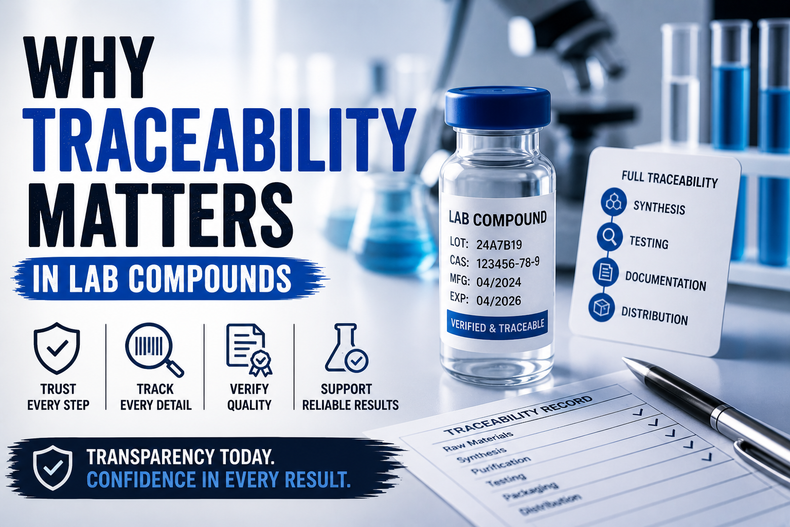
When a compound's history is unknown, so is its risk. Here is a clear look at why tracking the origin, handling, and condition of laboratory substances is one of the most important, and often underappreciated, practices in modern science.
What Does "Traceability" Actually Mean?
In a laboratory context, traceability refers to the ability to follow a compound's complete journey, from its source and manufacturer, through storage and handling, all the way to the moment it is used in an experiment or test. It answers three essential questions: Where did this compound come from? How has it been handled? And is it still what it is supposed to be?
Think of it like the supply chain label on a food product. Just as consumers expect to know where their ingredients originated and how they were stored, scientists and quality managers need the same confidence in every substance that enters their workflow.
"A compound without a documented chain of custody is, scientifically speaking, a compound you cannot fully trust, no matter how pure it looks."
The Real Risks of Poor Compound Tracking
When traceability breaks down, the consequences are not abstract. They show up in failed experiments, invalidated results, regulatory violations, and in clinical or safety-critical settings, they can pose genuine risks to human health.
Consider a scenario where a reagent is stored at the wrong temperature for a week, then relabeled and returned to inventory without a record of the incident. The next researcher who picks it up has no way of knowing the compound may have degraded. Their results could be skewed without any obvious explanation, wasting time, resources, and potentially influencing downstream decisions.
Degraded Results
Unstable or contaminated compounds can silently corrupt experimental data, making errors nearly impossible to trace back.
Audit Failures
Regulatory bodies in pharma, food science, and clinical research require documented compound histories. Gaps mean penalties.
Wasted Resources
Repeating experiments due to compound uncertainty is one of the most common, and preventable, drains on lab budgets.
Cross-Contamination
Without clear records, the movement of compounds between labs or personnel can lead to undetected mixing of substances.
Five Key Elements of a Strong Traceability System
Effective compound traceability is not just about labeling. It requires a consistent, system-wide approach that covers several interconnected areas:
- 1 Source documentation — Every compound should enter the lab with a clear record of its manufacturer, lot number, certificate of analysis, and purchase date. This forms the foundation of its identity.
- 2 Storage conditions log — Temperature, humidity, and light exposure can all affect compound stability. Automated environment monitoring, or at minimum regular manual records, should document storage conditions throughout a compound's time in inventory.
- 3 Chain of custody records — Who received the compound, who transferred it, who opened it, and who used it should all be recorded. This is especially critical in multi-user labs or shared facilities.
- 4 Expiry and stability tracking — Compounds do not last forever. A traceability system must flag compounds approaching expiry and record disposal to ensure nothing is used beyond its verified window of stability.
- 5 Usage and batch linking — Each experiment should be linked to the specific batch and lot of every compound used. If a problem surfaces later, this linkage allows rapid identification of all affected work.
How Regulatory Frameworks Shape the Requirement
Traceability is not optional in most professional laboratory settings. Regulatory frameworks across industries have embedded it as a baseline expectation.
In pharmaceutical research, guidelines from bodies such as the FDA and EMA require detailed records of every substance used in drug development and testing. The ICH Q7 guideline, which covers good manufacturing practice for active pharmaceutical ingredients, explicitly requires material traceability as part of quality management.
In clinical diagnostics, ISO 15189, the international standard for medical laboratory quality, ties measurement accuracy directly to the traceability of calibration materials and reagents. A diagnostic result is only considered reliable when the compounds producing it can be traced to internationally recognized standards.
Even in academic research, funding bodies and journals are increasingly requiring that experimental materials be documented in detail, partly in response to growing concern about reproducibility in published science.
Digital Tools and What They Change
Traditional traceability relied on paper logs, manual inventories, and binders of certificates. While these methods work, they are slow, prone to human error, and difficult to search when something goes wrong.
Modern laboratory information management systems (LIMS) and electronic lab notebooks (ELNs) have significantly improved the picture. When compounds are logged digitally at intake and tagged with unique identifiers, often barcodes or QR codes, their entire history can be retrieved in seconds. Usage is automatically linked to experiments. Alerts can be set for expiry dates. Environmental monitoring systems can feed data directly into compound records.
The shift to digital does not eliminate the need for disciplined processes, but it makes consistent, complete traceability far more achievable for labs of all sizes.
A Practical Starting Point for Labs Without a System
Not every lab has access to enterprise software or dedicated inventory specialists. For smaller operations or those starting from scratch, a few foundational steps can still make a meaningful difference:
- A - Create a simple intake form that captures supplier name, lot number, receipt date, storage conditions, and the person who received the compound. Even a shared spreadsheet is far better than nothing.
- B - Label every container clearly on arrival, including an internal identifier that connects back to the intake record. Relying on manufacturer labels alone means losing traceability the moment a label fades or is removed.
- C - Establish a sign-out log for shared compounds so that whenever someone removes a substance from inventory, the date and their name are recorded automatically or by habit.
- D - Run a short monthly audit. Cross-check what is physically on the shelf against what the records show. This catches discrepancies early, before they affect results.
Traceability as a Culture, Not Just a Checklist
Perhaps the most important shift any laboratory can make is treating traceability as a scientific value rather than an administrative burden. When researchers understand that good records protect their own work, not just satisfy an external requirement, the behavior becomes self-reinforcing.
A team that consistently documents its materials is a team that can defend its data, repeat its experiments, and build on its findings with confidence. That is ultimately what science depends on.
The Bottom Line
Traceability in lab compounds is not bureaucracy for its own sake. It is the thread that connects a result back to its materials, a finding back to its foundation, and a conclusion back to the conditions that produced it. Labs that invest in strong traceability practices produce more reliable science, navigate audits more easily, and waste fewer resources on unexplained failures. In a field where trust in data is everything, that thread is worth protecting.